


Understand how artificial intelligence chooses its sources and why companies need to think about GEO to strengthen their digital presence.
For more than two decades, building a digital presence meant competing for space in search engines. Companies invested in SEO, sponsored ads, and content production to appear among the top Google results, based on a relatively simple logic: the greater the visibility in searches, the greater the chances of attracting visitors, generating business opportunities, and winning new customers.
This model shaped the internet as we know it today. Websites began to be structured to answer search intents, content was organized around keywords, and metrics such as organic traffic, click-through rate, and ranking became fundamental indicators for any digital marketing strategy.
Although this reality continues to be part of the daily lives of companies, it no longer alone explains how people discover products, services, and brands. Among Generation Z, this shift is already a consolidated behavior: we show in How Generation Z uses social media. a significant portion of this generation already searches outside of Google first.
In recent years, a new layer has come to mediate this relationship: Generative artificial intelligences.
Tools such as ChatGPT, Gemini, Claude, Perplexity and himself Google, through the AI Overviews and AI Mode, These technologies are transforming the search experience. Instead of browsing through dozens of pages to find an answer, millions of people have started asking questions directly to an AI and receiving a ready-made recommendation, built from different sources of information.
This change may seem like just an evolution of the search experience, but it represents a much deeper transformation. For the first time since the popularization of the internet, the competition for attention is no longer exclusively between pages of results, but is now also taking place within the answers produced by artificial intelligence.
In this new scenario, having an online presence remains essential. But it becomes equally important to be understood by AI as a reliable source of information.
It is precisely from this change that a concept has emerged that is gaining traction among researchers, technology professionals, and marketing specialists: Generative Engine Optimization, or simply GEO.
This transformation has already begun.
Until recently, GEO was treated as a predominantly academic topic. Today, it's already part of the strategy of some of the world's biggest brands.
In 2026, executives from companies like American Eagle, Coach, and Chime revealed that increasing brand presence on platforms such as ChatGPT, Gemini, and other generative mechanisms has become a priority for marketing teams.
This shows that the discussion is no longer just about SEO or traditional search engines. The challenge now is also to get artificial intelligence to recognize a brand as a reliable source of information.
This movement indicates that GEO is rapidly moving away from being a trend and becoming a strategic competency for companies that want to remain relevant in the digital environment.
The magnitude of the change, in numbers.
The shift from traditional search to AI-generated answers is not a prediction for the future. The data already shows the shift:
- 25% drop in traditional search volume by 2026 This is Gartner's prediction, with search marketing losing ground to chatbots and AI agents (Gartner).
- Over 900 million people use ChatGPT every week., and the app surpassed 1 billion monthly users in 2026 (DemandSage).
- Brazil is the 3rd country that uses ChatGPT the most in the world., with around 140 million messages sent per day, according to data from OpenAI itself (InfoMoney).
- 68% of Google searches are now ending without any clicks. on external websites, according to a 2026 study (Search Engine LandIn AI Mode, the zero-click rate reaches 93% (Semrush).
- Being cited pays off: brands mentioned in an AI Overview register higher CTR 35% than those that are left out of the answer (Seer Interactive).
Our analysis at follow55 is that clicks are shrinking, but citations are becoming increasingly valuable. GEO is the discipline that works with this new asset.
The way we discover brands is changing.
Every major technological transformation also alters people's behavior.
When social media gained prominence, companies had to learn that simply communicating was no longer enough. Building relationships was essential. When smartphones became the primary mode of browsing, thinking about mobile experiences became indispensable. Now, with the consolidation of generative artificial intelligence, we are experiencing another significant shift.
Users still want quick answers, but are showing less and less interest in navigating through a series of pages to find them.
Instead of searching for "best software for real estate agencies," he asks ChatGPT which platform best suits his profile. Instead of opening multiple websites looking for a company specializing in app development, he asks Gemini which suppliers are leaders in that segment. Instead of comparing dozens of articles on a particular subject, he requests that an AI do the synthesis for him.
The search process is no longer just a list of links, but a conversation.
This change profoundly alters the logic of digital discovery. For years, the challenge for companies was to achieve a privileged position in search engines. Now, the challenge is to become part of the set of sources considered relevant by artificial intelligence models.
This change also alters how companies need to produce content.
For years, much of SEO strategy has been built around keywords.
In artificial intelligence, behavior changes completely. Whereas before someone would search:
Real estate CRM
Today it's common to ask:
Which real estate CRM is best suited for a real estate agency with ten brokers that wants to integrate marketing and sales?
The question ceases to be a keyword and begins to represent a complete context. This means that companies need to understand much better the real doubts of their customers in order to produce content capable of answering conversations, and not just surveys.
The origin of the term GEO – Generative Engine Optimization
the term Generative Engine Optimization (GEO) It gained notoriety in 2024 when researchers from Princeton University, Georgia Tech, IIT Delhi, and the Allen Institute for AI published a study proposing a new perspective on content optimization for generative search engines. The research demonstrated, in an experimental setting, that certain strategies were able to significantly increase the visibility of content in responses generated by artificial intelligence, reinforcing the idea that optimizing for generative models requires different approaches than those used by traditional search engines.
Study reference: https://arxiv.org/abs/2311.09735
The study highlighted a paradigm shift. For years, companies have invested in techniques to improve their ranking on search engine results pages. GEO This proposes a different reflection: how can we make an artificial intelligence consider certain content relevant enough to use it as a basis for constructing an answer?
This change shifts the focus from simple visibility to building authority.
While the SEO it seeks to increase the likelihood of a user clicking on a link, the GEO The goal is to increase the likelihood of an AI trusting that content. These are different, yet complementary, objectives.
SEO remains fundamental, but it's no longer sufficient.
Whenever a new technology emerges, hasty predictions appear about the end of previous ones. This was the case when social networks grew, when apps gained ground, and now it's happening again with artificial intelligence.
It didn't take long for headlines to appear claiming that "SEO is dead" or that "nobody uses Google anymore." In practice, this view simplifies a much more complex reality. SEO remains an essential discipline for ensuring that content is found, indexed, and understood by search engines. In fact, a large part of artificial intelligence depends on the existence of well-structured and reliable public content to form its knowledge base or supplement answers via the web.
What has changed is not the importance of SEO, but rather the role of digital presence. Before, it was enough for a page to be found by people. Now, it also needs to be understood by machines. This requires a broader approach to information architecture, content organization, data consistency, digital reputation, and authority building.
| Traditional SEO | GEO |
|---|---|
| SEO | GEO |
| Keywords | Questions |
| AI | |
| Ranking | Trust |
| Clicks | Quotes |
| Page | Knowledge |
GEO requires a new mindset.
In the SEO era, companies competed for clicks. In the GEO era, they compete for trust.
An interesting consequence of this transformation is that companies are no longer producing content solely for campaigns or to improve their Google rankings.
In practice, organizations that want to gain relevance in the responses of artificial intelligence need to operate as true producers of knowledge.
This means continuously publishing useful content, answering specific customer questions, sharing practical experiences, and disseminating research, case studies, documentation, and proprietary analyses. The greater the amount of original knowledge available about a brand, the greater the opportunities for this content to be used as a reference by generative mechanisms.
Producing content is no longer a one-off marketing action, but has become part of the ongoing construction of the company's digital authority.
How do artificial intelligences choose their answers?
This is perhaps the main question for those starting to study. GEO. There's a tendency to imagine that tools like ChatGPT or Gemini simply search Google and rearrange the results. While some platforms do consult up-to-date information on the web in certain contexts, the process of constructing the answers is much more sophisticated.
Generative models combine previously trained knowledge, conversational context, and, when available, information obtained from external sources to produce a unique response. Instead of copying a single piece of content, they synthesize different references, identify patterns, relate concepts, and present an explanation in natural language. This means that the competition for visibility no longer depends solely on ranking position but on the ability of a piece of content to convey meaning. clarity, authority, depth and reliability.
The very study that introduced the concept of GEO The researchers observed that content with objective language, statistical information, citations from recognized sources, and good organization were more likely to be used by generative mechanisms. Another important point highlighted by the researchers is that different themes respond better to different strategies, indicating that there is no single formula that works for all segments.
This conclusion reinforces an important idea: that artificial intelligences don't just look for well-positioned pages, they also look for sources capable of supporting an answer.
GEO as a consequence
A common interpretation about GEO is to treat it as a substitute for SEO. However, this interpretation is limited, as GEO does not represent a break with everything that has been built up to this point. It is a natural evolution of how information circulates on the internet.
Companies that produce relevant content, organize their information well, keep their websites updated, build authority, and invest in consistent digital experiences naturally increase their chances of being understood by artificial intelligence. That's precisely why... We believe that GEO should not be treated as an isolated technique..
GEO is a consequence of something much larger, like a well-built digital ecosystem. This vision directly relates to another topic we've already discussed here at follow55: digital ecosystems.
👉 Read also: Why brands need to think about Digital Ecosystems
https://follow55.com.br/por-que-marcas-precisam-pensar-em-ecossistemas-digitais/
For a long time, companies viewed websites, social media, CRM, ERP, apps, and content production as independent initiatives. Today, it is becoming increasingly clear that all these assets are part of a single system. The greater the integration between technology, content, data, and experience, the greater a brand's ability to be understood, not only by people but also by artificial intelligence.
This knowledge isn't built solely on websites. Videos, interviews, documentation, published studies, technical communities, and other formats also contribute to shaping the perception that artificial intelligence develops about a brand. The more consistent this body of evidence distributed online is, the greater the chances of a company being recognized as a reliable source.
And it is precisely this understanding that determines who will be cited in the responses generated by AI models.
What really influences an AI to mention a brand?
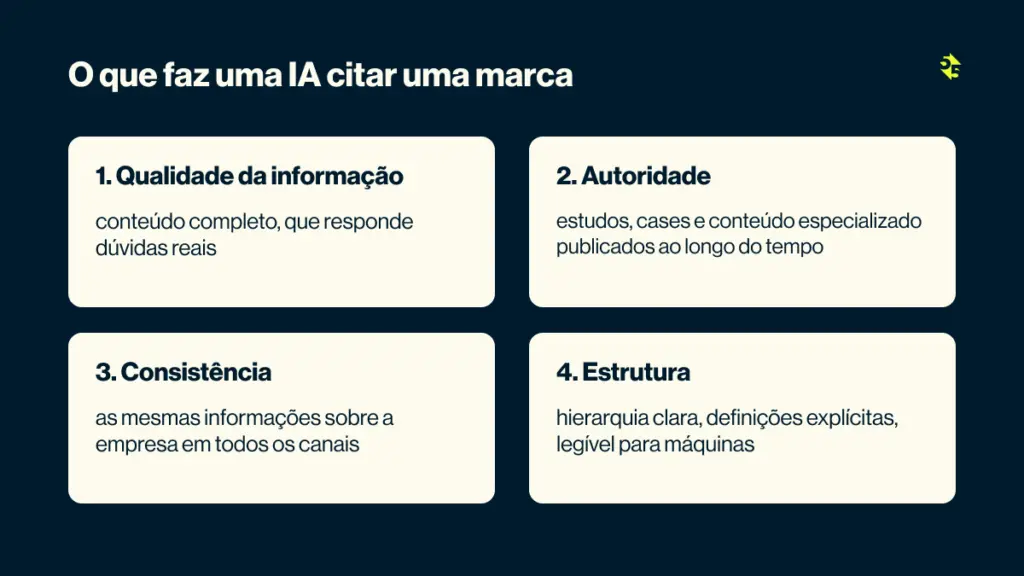
One of the most frequently asked questions about GEO The question is whether there is some kind of "algorithm" capable of guaranteeing that a company appears in the ChatGPT or Gemini responses. The answer is no.
Just as Google has never revealed all the factors it uses to rank pages, there is also no public formula that determines exactly how generative models choose their sources. Furthermore, different platforms use distinct architectures, knowledge bases, and information retrieval mechanisms.
However, this does not mean that everything is unpredictable. By observing academic research, technical documentation, and the behavior of these platforms, some patterns are beginning to repeat themselves.
The first of these is the quality of the information.
Artificial intelligence tends to favor complete, contextualized content capable of answering real questions. Texts that are excessively superficial or produced only to repeat keywords offer little value to a model whose function is to build consistent answers.
Another important factor is authority.
A company that publishes studies, case studies, technical articles, research, and specialized content transmits much stronger signals of credibility than an organization whose digital presence is limited to an institutional page with little information.
The consistency of the published information is also gaining importance.
Company name, service description, areas of expertise, team, location, contact information, and other institutional details must be consistent across all digital channels. When different sources present conflicting data, trust tends to decrease.
There is also an aspect that is often overlooked: the structure of the content.
Although AI is capable of interpreting complex texts, well-organized, hierarchically structured, and clearly written content facilitates understanding of the context and increases the likelihood of it being used as a reference. Ultimately, these best practices aren't very different from what has always earned a brand trust in the digital environment. The difference is that now this trust is also being evaluated by machines.
Content is no longer just competing for clicks.
For many years, a large part of content marketing strategies was built around metrics such as visits, time spent on the site, and conversions. These indicators remain important, but they no longer tell the whole story.
When a user asks a question to an artificial intelligence, it can resolve their need without accessing any website. This means that part of the value produced by content is no longer associated solely with clicks, but becomes related to the ability to influence the answer presented to the user.
This is a significant change, as the company can contribute to thousands of AI-generated answers without necessarily receiving thousands of direct visits. This doesn't diminish the importance of content; on the contrary, it increases its responsibility. Producing content now means building knowledge that will be used by people and, increasingly, by artificial intelligence.
The importance of digital authority
There is a well-known concept in marketing: Strong brands are often remembered even before they are searched for. In the world of artificial intelligence, this logic takes on a new dimension: the greater a company's digital reputation, the greater its presence tends to be in the set of information available to generative models.
But this reputation is not born from a single action; it is built by the sum of different signals distributed over time.
- Published articles
- Success stories
- Mentions in specialized media
- Research production
- Original content
- Technical documentation
- Market research
- Educational materials
All of this helps build a consistent history of who that company is and what authority it holds on a given subject. This is precisely why organizations recognized in their markets tend to appear more frequently when we ask artificial intelligence about a particular segment.
GEO starts before the content.
When it comes to optimization for generative mechanisms, There is a natural tendency to focus all attention on producing articles. In practice, this is only one component, as a consistent strategy of GEO It begins long before any text is published.
It encompasses the website's architecture, information organization, loading speed, accessibility, user experience, semantic page structure, structured data, integration between different channels, and how the company presents its digital identity.
In other words, it starts with ecosystem. Companies that treat each digital asset as an isolated project end up producing fragmented signals. Organizations that connect... technology, content, data and experience They build a much more consistent presence.
That is precisely the vision we advocate in follow55. We don't see websites, apps, systems, blogs, or platforms as independent initiatives. They are all part of the same thing. digital ecosystem.
And the more integrated this ecosystem is, the greater its capacity to generate value for users and for artificial intelligence.
Is AI-generated content enough to build relevance?
The popularization of artificial intelligence has also brought a false sense of ease. Today, any company can generate dozens of articles in a few minutes using models like ChatGPT, Gemini, or Claude. This democratizes content production, but it doesn't necessarily mean it's building authority.
Search engines and AI platforms themselves don't evaluate content solely based on how it was produced, but primarily on the value it delivers. An article written with artificial intelligence can be excellent when it includes curation, practical experience, human review, and an original perspective on the topic. Similarly, a text written entirely by a person can be superficial, inaccurate, and irrelevant.
The difference lies not in who wrote the content, but in the knowledge it conveys. Companies that merely reproduce information already available on the internet tend to contribute little to the digital ecosystem. On the other hand, organizations that share genuine experiences, their own studies, project learnings, market analyses, and well-founded viewpoints build a much more valuable asset: original knowledge.
Perhaps this is one of the biggest changes brought about by GEO. Artificial intelligence has made content production more accessible, but it has also raised the bar for what truly deserves to be cited. In a scenario where anyone can publish thousands of words in a few minutes, the competitive advantage is no longer about producing more, but about producing better.
Artificial intelligence doesn't need more content. The internet already has an abundance of content. What it needs are reliable sources. And trust isn't something that's generated with a prompt; it's built over time through consistent knowledge, practical experience, and a digital presence capable of demonstrating authority. Perhaps that's the main difference between producing content and building relevance.
Conclusion
THE GEO This does not represent the end of SEO, nor a break with everything that has been built in recent decades. It represents a natural evolution in how information is discovered, interpreted, and used in an environment increasingly mediated by artificial intelligence.
Just as SEO was never solely about keywords, GEO will not be solely about producing content for generative models. Companies that view this shift merely as a new technique will likely achieve limited results.
Here at follow55, We believe that the visibility in artificial intelligence responses will be a consequence of something much bigger: a digital ecosystem capable of integrating technology, content, data, and experience into a single strategy.
Regardless of which platform comes to dominate this market in the coming years, the principle remains the same: artificial intelligence depends on reliable knowledge to build answers. That's precisely why investing in authority, knowledge, and consistency will continue to be a relevant strategy, regardless of the technology used.
Because the most relevant brands will not necessarily be those that appear first, but rather those that have built enough recognition to be considered a trusted source.
Continue reading
If you enjoyed this content, we also recommend:
- Why brands need to think about Digital Ecosystems
https://follow55.com.br/por-que-marcas-precisam-pensar-em-ecossistemas-digitais - Discover our projects
https://follow55.com.br/projetos
Frequently asked questions about GEO
What is GEO (Generative Engine Optimization)?
GEO is the set of strategies that increase the chances of a brand or content being used as a reference by artificial intelligence mechanisms, such as ChatGPT, Gemini, Claude, Perplexity, and other generative platforms.
Does GEO replace SEO?
No. SEO and GEO are complementary. While SEO aims to improve visibility in traditional search engines, GEO seeks to strengthen the brand's presence within the results generated by artificial intelligence.
How can a company improve its GEO strategy?
Investing in original content, information organization, digital authority, structured data, user experience, and an integrated digital ecosystem.
Does Google use artificial intelligence in its search engines?
Yes. Google has been incorporating features like AI Overviews and AI Mode, which use artificial intelligence to generate more complete answers directly on the results page.
Do ChatGPT and other AIs use information from the internet?
References
- Princeton University, GEO: Generative Engine Optimization
https://arxiv.org/abs/2311.09735 - Google Search Central, Creating Helpful, Reliable, People-First Content
https://developers.google.com/search/docs/fundamentals/creating-helpful-content - Google Search Central, AI Features and Search
https://developers.google.com/search/docs/appearance/ai-features - OpenAI, ChatGPT Search
https://openai.com/index/chatgpt-search/





 Portuguese
  English