

Understand what OpenAI launched with Businesses in ChatGPT, who can already claim the profile in Brazil, and why it helps, but doesn't replace, the reputation your brand builds outside of it.
On November 10, 2026, OpenAI launched the Businesses in ChatGPT beta, and with it came something the market had been asking for since AI became the starting point for research: a company profile on ChatGPT. For the first time, a brand can officially claim how it appears within the assistant, update its own information, and see, albeit in an aggregated way, how people reach it in conversations.
For those leading marketing, this new development presents both a practical decision and a strategic question. The decision is whether it's worthwhile to claim the profile now, while it's still in beta, and who within the company should handle it. The deeper question is: if an official panel exists, does it solve the issue of being cited by AIs, or is it just another piece of a larger puzzle?
In this article, we explain what a company profile is on ChatGPT, what it allows you to do, who can already use it in Brazil, what it doesn't do (and OpenAI itself makes this clear), and how to prepare your brand to take advantage of the feature without making the mistake of thinking that registration replaces reputation.
The magnitude of the change, in numbers.
- Scale: according to OpenAI, ChatGPT is used by 1.2 billion people every week.
- Adoption in Brazil: 77% of Brazilians use some type of artificial intelligence tool, according to Bain Consumer Pulse 2026, by Bain & Company (Mobile Time).
- Product search: The share of Brazilian online consumers using ChatGPT to search for products jumped from 2% in 2024 to 32% in 2026, while Google's share fell from 79% to 63%, according to the Global Digital Shopping Index 2026, by PYMNTS Intelligence with Visa.Retail Center).
- Cross-checking: 58% of consumers check AI-generated recommendations on other sources before buying, according to the Future Shopper report by VML (Media & Message).
- Customer service by agents: a Gartner It projects that, by 2028, 60% of brands will use agency AI to conduct individual interactions with customers.
The numbers tell the same story from different angles: people are already researching brands within AI, and now platforms are starting to offer companies an official gateway to participate in this conversation. The company profile on ChatGPT is the first version of this gateway at scale.
What is a company profile on ChatGPT?
The company profile on ChatGPT is a brand's official page within the assistant. It's managed by the Business Hub, the panel OpenAI created for owners or authorized representatives to claim the company, keep information updated, and track how people interact with it. When a company appears in a response, the user can open this profile to see more details, visit the website, or, if available, chat with the brand's representative.
The process has two stages. First comes the claim, which proves the connection to the business through a business phone number, business email, a TXT record on the website's domain, or a connection to a Shopify store. Then comes the identity verification, done by Persona, which may request an official document, company registration, and proof that the person is authorized to represent it. Only after this second approval does the profile receive the blue verified badge and unlock the publication of changes, insights, and the product feed, according to the... OpenAI Help Center.
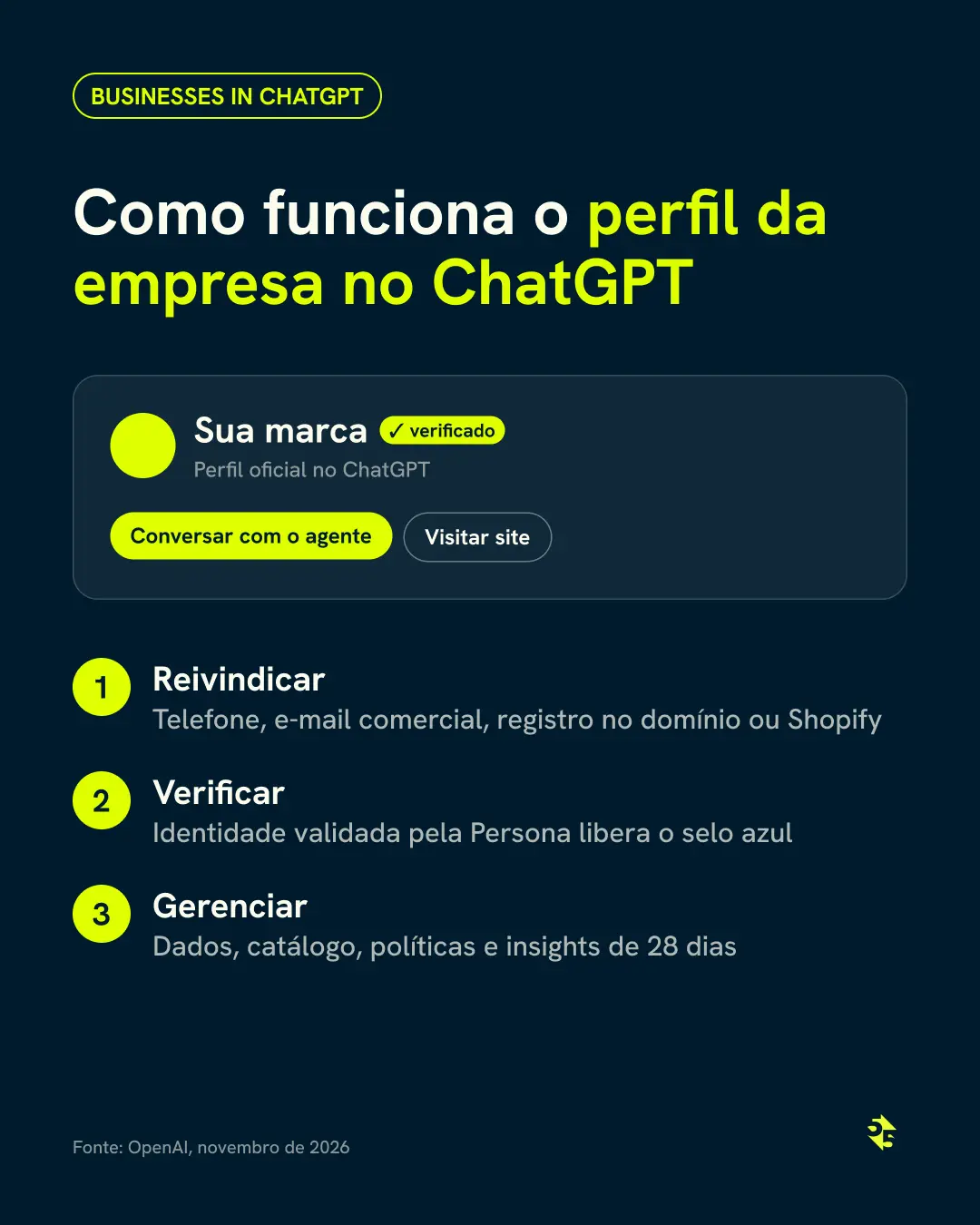
With a verified profile, the business can edit its website, description, category, logo, cover photo, and shipping and return policies. All changes are reviewed by OpenAI before going live. Businesses with a catalog can connect a product feed with prices and availability, either by file or URL, and Shopify merchants can use their existing catalog.
The data portion is of most interest to those working in marketing. The dashboard shows, over a 28-day period, the number of mentions, clicks to the website, and discovery topics, which are recurring themes in conversations where the brand was mentioned. There's an important detail: for online businesses, a mention only counts when ChatGPT cites the company's website, not when only the brand name appears in the text. OpenAI also doesn't share individual conversations, and the numbers only appear when the volume of interactions reaches minimum privacy thresholds.
Among Brazilian online consumers, the use of ChatGPT to research products increased from 2% in 2024 to 32% in 2026.
Global Digital Shopping Index 2026, PYMNTS Intelligence and Visa
Business Agents: the service that begins within the response.
The second layer of the launch is Business Agents. After claiming their company profile on ChatGPT, eligible businesses can create, test, and publish their own agent, which answers questions about products, services, and policies using information and guidance provided by the brand. The conversation with the agent is identified as such and remains separate from ChatGPT's independent responses, preserving the distinction between what the assistant recommends and what the company says about itself.
For now, agents are only available to eligible e-commerce and online service businesses in the United States, and OpenAI says it intends to bring them to other markets and categories over time. It's also worth knowing what they don't do: according to the Help Center, the agent explains products and policies and directs the customer to the website, but does not complete purchases, reservations, or order inquiries. Companies can still sponsor the agent and use it as an ad destination on ChatGPT, with insertions identified as sponsored.
This is where Gartner's prediction about agentic AI ceases to be abstract. If pre-sales service starts happening within a third-party platform, the quality of the information that the brand delivers to that agent becomes part of the customer experience, with the same importance as a good service script.
Who can claim the profile in Brazil today?
OpenAI's general rule is that any eligible business located where ChatGPT is available can claim a profile through the Business Center. In practice, the Help Center details that e-commerce and online service businesses can claim a profile, while brick-and-mortar stores and restaurants, for now, can only claim listings that already exist in the United States. Eligibility also depends on the industry, according to the platform's policies, and the page does not publish a list of countries.
For a Brazilian company with its own website, such as an e-commerce business, a software company, or a B2B services company, the path to having a company profile on ChatGPT tends to be open, provided the verification is accepted. The agent, however, is not yet available here. As everything is in beta, the recommendation is to check eligibility directly on the Business Hub before planning any action regarding the feature.
A profile helps, but it doesn't replace reputation.
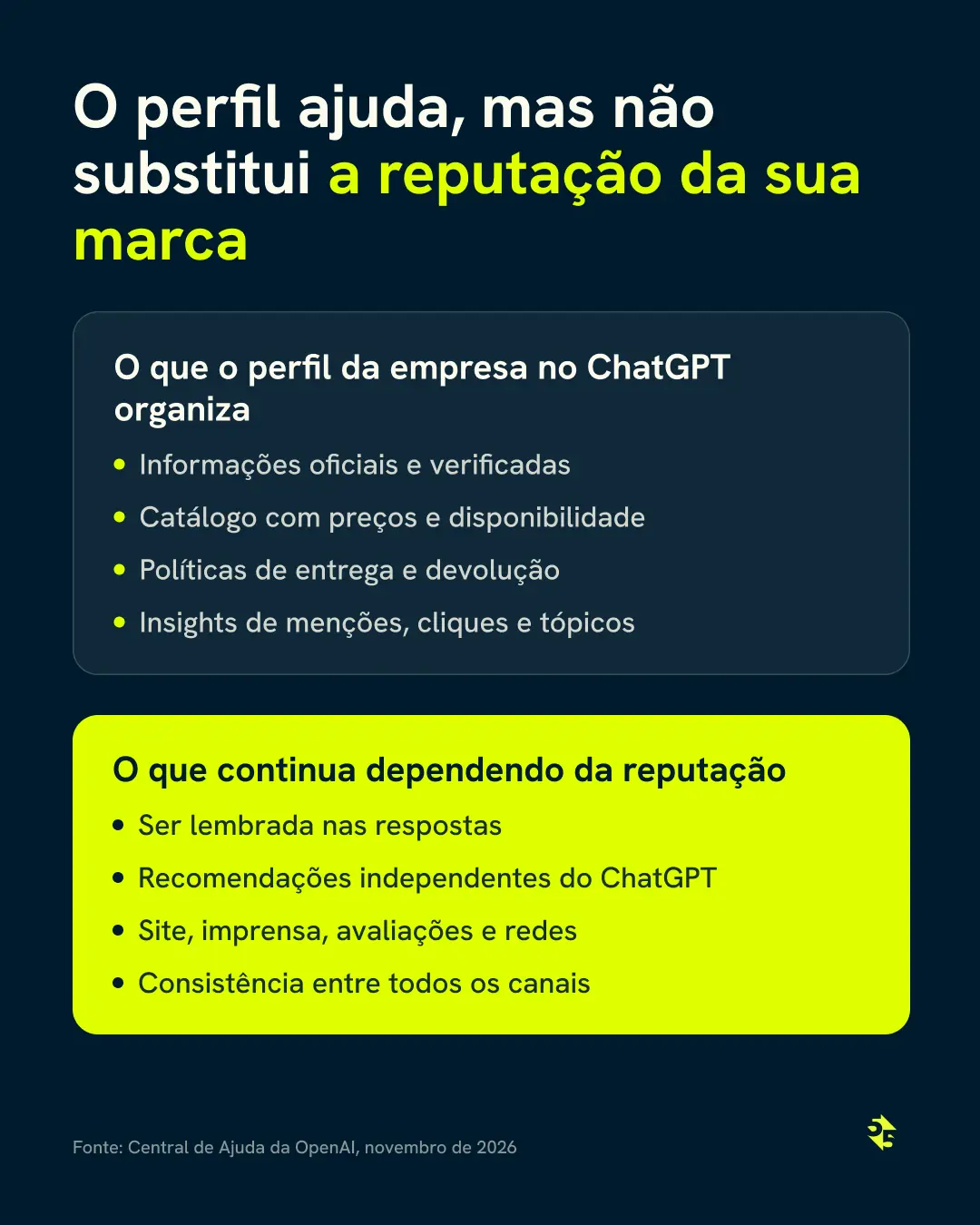
There's a phrase in the OpenAI documentation that every marketing manager should read carefully. When the Help Center asks if claiming a profile increases visibility or ranking, the answer is no: the profile allows you to manage the information your company provides, but it doesn't guarantee more visibility or control over ChatGPT's independent recommendations, and advertising doesn't influence those results. The same page warns that ChatGPT may use other sources besides the profile.
We believe this is the central point of the innovation. The company profile on ChatGPT organizes official information and gives the brand its own showcase once it has already been remembered, but the decision to remember it still depends on what the AIs find about the company on the rest of the internet: the website, the press, reviews, social networks, directories, and content that other people produce about it. This is exactly the territory of... GEO (Generative Engine Optimization), ...and that's why the profile complements, rather than replaces, the work of appear on ChatGPT.
Recent history helps to illustrate this trend. When Google popularized business profiles in local search, registering a business became basic hygiene, but those who were chosen were those with good reviews, consistent information, and a relevant presence on other channels. ChatGPT seems to follow a similar logic, with one difference: the consumer doesn't see ten results side-by-side, but receives a summary. When AI mentions few brands per response, the competition for brand recall becomes more concentrated.
58% of consumers check AI-generated recommendations on other sources before making a purchase.
Future Shopper, VML
This fact-checking behavior reinforces the argument and changes the role of the company's profile on ChatGPT within the strategy. If more than half of people check the AI recommendation elsewhere before deciding, the consistency between the ChatGPT profile, the website, Google, and social networks ceases to be an operational detail and becomes a factor of trust. We have been arguing for some time that brands need to think about... digital ecosystems, And the ChatGPT profile is just another point in this ecosystem, which only works well when it interacts with others.
How to prepare your brand for your company profile on ChatGPT
Even in beta, there's work that can be done now that's worthwhile regardless of how the feature evolves. At follow55, we've organized preparation into six areas:
- Define who owns the profile: The claim requires someone with formal authorization to represent the company and, in many cases, access to the website domain for TXT registration. Use the legal name that appears in the official registration and leave the trade name in the appropriate field. Then, the administrator can grant access to colleagues or the agency, each with their own account.
- Align the information across all channels: Description, category, website, hours, policies, and contact information must all be consistent across the profile, website, Google, and social media. Discrepancies confuse consumers who check sources and even the AI systems that cross-reference them, weakening the company's ChatGPT profile from the outset.
- Organize the catalog: For those who sell online, a clean product feed with correct prices and availability is the foundation for ranking well when the question is about a product. Connecting the feed doesn't guarantee recommendations, but a feed with errors certainly hurts.
- Review policies and support pages: Delivery, exchange, return, and frequently asked questions information is essential for both the profile and the potential agent. Clear and up-to-date text on the website is the raw material for any accurate answer.
- Measure the starting point: Before making a claim, record how AIs describe your brand today, in which questions it appears, and which competitors are cited instead. Without this baseline, it's impossible to know if the work has yielded results.
- Read the insights critically: Remember that, in online business, a mention only counts when the website is cited, and a blank field may indicate volume below the threshold, not a lack of activity. The company profile data on ChatGPT is a useful indicator, which works best when combined with AI-powered presence monitoring and the website's own data.
Frequently Asked Questions
What is Businesses in ChatGPT?
This is the set of features that OpenAI launched in beta in November 2026 to bring companies and users closer together within ChatGPT. It brings together the Business Center, where the company claims and manages the profile, and the Business Agents, who answer questions about products and services on behalf of the brand.
Can Brazilian companies already have a company profile on ChatGPT?
E-commerce and online service businesses located where ChatGPT is available can claim a profile, provided they are eligible and pass verification. Physical stores and restaurants, for now, can only claim existing listings in the United States, and agents are also restricted to the American market.
Claiming a profile will make my company appear more on ChatGPT?
Not necessarily. OpenAI itself states that the profile doesn't guarantee more visibility or control over the assistant's independent recommendations. What increases the chances of being cited is the brand's authority in the sources that AIs consult, a topic we explain in our guide on [topic]. What is GEO?.
What metrics does the profile show?
The dashboard displays, over a 28-day period, the number of mentions of the company, clicks to the website, and discovery topics. The data is aggregated, does not show individual conversations, and only appears when the volume of interactions reaches a minimum defined by OpenAI.
Do I need to advertise or create an agent to have a profile?
No. According to OpenAI's Help Center, you don't need an advertising account or an Enterprise contract to claim a profile. Claiming, verifying, publishing an agent, and advertising are independent steps.
Ready to prepare your brand for AI responses?
The company profile on ChatGPT is good news for those who take their digital presence seriously, because it gives brands an official way to manage the information they provide to AI. It also leaves a clear lesson: the panel organizes what the company says about itself, while brand recognition continues to be built on what the market says about it. Claiming the profile is a simple process, while the reputation that supports the recommendations is built over time.
At follow55, we help companies map how they appear in artificial intelligence and build the presence that makes them citable, within our area of expertise. Growth. Learn about our latest project, the Lano, and other digital presence tasks such as Aucta Capital and CADBIM.
References
- OpenAI. We feature companies on ChatGPT., November 2026.
- OpenAI Help Center. Setting up your business on ChatGPT.
- Gartner. Marketing Predictions for 2026.
- Retail Center. ChatGPT reaches 32% in product searches., October 2026.
- Media & Message. Consumers are turning to AI before deciding what to buy., September 2026.
- Mobile Time. Bain Consumer Pulse 2026, April 2026.




 Portuguese
 English