

Google's ChatGPT, Gemini, and AI Mode are looking for answers on LinkedIn, YouTube, and Reddit. Understand why this changes the role of social media in your brand strategy.
For a long time, the conversation about social media and AI went in only one direction: AI helping to write posts, captions, and scripts. The data from 2026 They show the opposite path, and it's much more interesting for those who manage brands. Now, social networks are fueling the answers that ChatGPT, Gemini, Perplexity, and Google's AI Mode deliver to people.
Try this: ask an AI which company is best suited to solve a problem in your industry. Pay attention to the sources. It's very likely that a LinkedIn post, a YouTube video, or a Reddit thread will appear in the answer. Sometimes your brand will be mentioned. Often, a competitor's will be mentioned.
In this article, we've compiled the most recent studies on the relationship between social media and AI, shown what they reveal (and what they don't yet reveal), and explained how, at follow55, we approach social media within an AI visibility strategy.
The magnitude of the change, in numbers.
- From 4.9% to 7.2%: This represents the growth of social media as a source of AI responses between January and August 2026, an increase of 47%. The data comes from a... Goodie study which analyzed more than 1.8 million citations across 10 AI tools and 29 social domains.
- Almost three times the size of the brand's website: During the same period, companies' own content accounted for between 2.5% and 2.8% of citations. In other words, AI already cites more what is said about your brand on social media than what your brand says about itself on its website.
- LinkedIn was the biggest growth driver: It went from about 8% to something close to a fifth of citations coming from social media in three months. In Perplexity, LinkedIn already accounts for approximately a third of social citations.
- Two out of three AI Overviews: They cite at least one social or community source, according to SE Visible data compiled by Planable. In organic Google search results, 76,731 out of 100,000 keywords analyzed by SE Ranking had at least one social result in the top 10.
- The search continues in the game: In 89% cases, those who use AI to research a purchase also resort to traditional search, according to the State of Ecommerce 2026, by Similarweb.
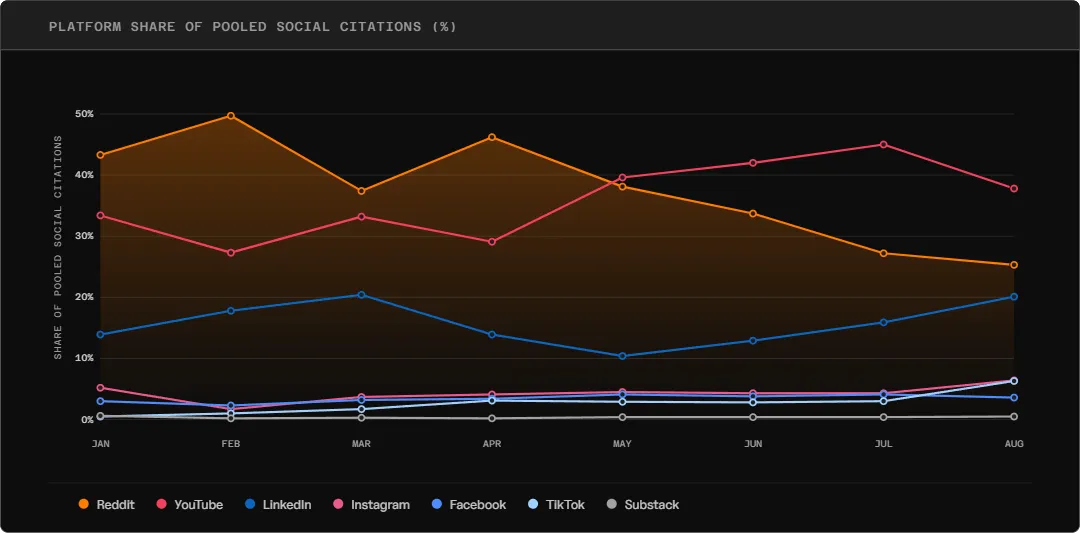
Taken together, these numbers tell a simple story: the response your customer receives from AI is being assembled from pieces of sources that go far beyond your website.
AI already cites more of what is being said about your brand on social media than what your brand says about itself on its website.
Why did AI seek answers on social media?
This makes sense when you think about what an AI looks for to put together an answer. It needs recent content, written in natural language, and with signs that real people are discussing that topic. Social media delivers exactly that, in volume and with daily updates.
A company website typically talks about the company for the company. A good discussion on LinkedIn or in a community addresses the customer's problem, using the customer's own words. For a model that attempts to answer "what's the best tool for X" or "how to solve Y," the second type of content is much more useful.
We've seen this movie before, but on a different scale. When Google started prioritizing useful content over pages designed for robots, many brands discovered they had a beautiful but irrelevant website. Now the criteria are being repeated, but the playing field has gotten bigger: everything your brand, and its people, publish outside of the website is now included.
Social networks and AI: what the Planable experiment teaches us.
The most practical data we found comes from a test by Planable itself, a social media management software company. They transformed blog content into LinkedIn articles, choosing topics that AI was already citing. Of the 25 articles published, 8 appeared in 422 AI responses, spread across 64 different questions. Google's AI Mode accounted for almost two-thirds of these citations.
Now comes the part that caught our attention the most. According to George Danaila, the company's content manager, YouTube videos, carousels on LinkedIn and Instagram, and even a dedicated subreddit didn't noticeably change visibility. What finally worked was publishing the articles on the professionals' personal profiles, not on the brand's page.
What finally worked was publishing the articles on the professionals' personal profiles, and not on the brand's page.
George Danaila, content manager at Planable
It's a one-company experiment, and Planable itself treats the finding as something to test, not as a rule. Even so, it confirms something we've been arguing for a long time: a brand's authority also resides in the people who make the brand. The profile of the founder, the marketing director, or the technical specialist can now be as important an AI visibility asset as the institutional website.
Each AI has its own diet (and it changes without warning).
It would be dishonest to treat these numbers as a definitive guide. The same Goodie study recorded 16 changes in the way AI models chose their social sources over seven months. Five of them reversed a previous change. None were announced by the AI companies.
And each tool has its preferences. In Goodie's analysis, Reddit accounted for 89% of ChatGPT's social mentions. LinkedIn dominated DeepSeek's. YouTube led in Perplexity, which simultaneously tested LinkedIn and decided to keep it. It's as if each AI read a different newspaper in the morning and switched subscriptions from time to time.
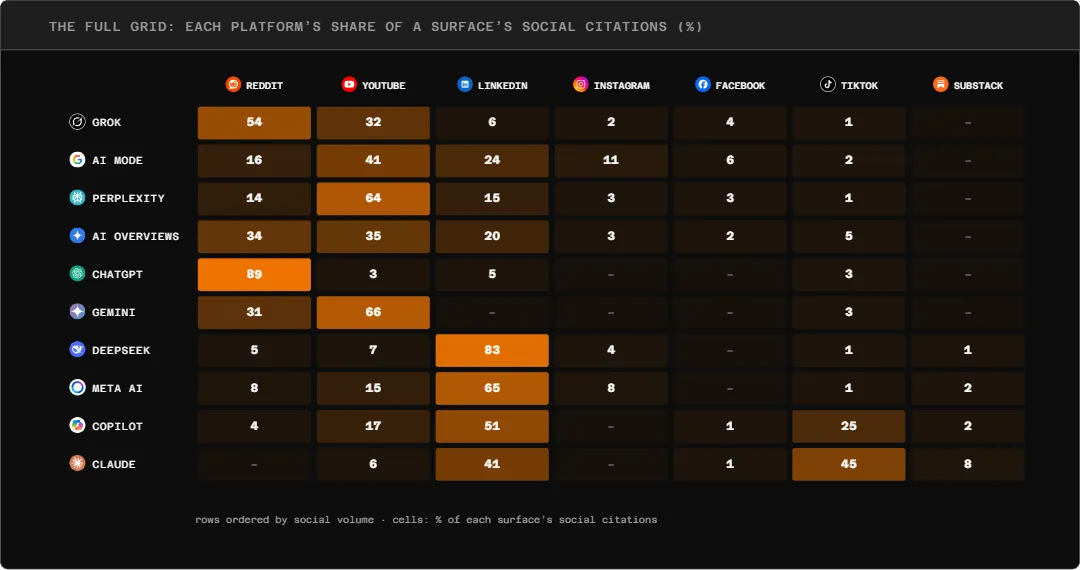
Therefore, we believe that chasing the platform of the moment is a weak strategy. Those who bet everything on the channel that AI is citing this month are building on shifting ground. The most solid path is to be present, with consistency and genuine content, in the places where the conversation in your sector happens.
Chasing the platform of the moment is fragile. What holds up is a consistent presence where the conversation in your industry is happening.
How to put this into practice for your brand.
The list below is the starting point we use at follow55 when looking at a customer's presence in AI responses.
- Discover what AI already reveals about your market: In ChatGPT, Gemini, and AI Mode, ask the questions your client would ask and note which sources appear. This map shows where the conversation takes place.
- Activate people, not just the page: Leaders and experts who regularly post on LinkedIn build authority that a company page alone can hardly achieve.
- Write to respond, not to show off: Content that answers a specific question, using data and personal opinion, is much more likely to be cited than institutional posts.
- Connect the networks to your website: Social media expands reach, but the website remains the foundation of credibility. A coherent ecosystem repeats the same message across all touchpoints.
- Monitor frequently: Since sources change without warning, monitoring brand presence in AI responses needs to become routine, not just an annual diagnostic.
It's the same reasoning we presented when we explained... What is GEO (Generative Engine Optimization)?Visibility in AI is a consequence of a well-built ecosystem, not an isolated trick.
Frequently Asked Questions
Do social media platforms help my brand appear on ChatGPT?
They can help. Studies from 2026 show that social media accounts for a growing share of the sources cited by AI, with YouTube, Reddit, and LinkedIn standing out. The effect depends on a consistent presence and content that answers real questions from your audience.
Which social network does AI mention most often?
It depends on the tool and changes frequently. In the period analyzed by Goodie, YouTube and Reddit led in social mentions, and LinkedIn was the fastest-growing platform. ChatGPT relied heavily on Reddit, while Perplexity expanded its use of LinkedIn.
Is it better to post on a personal profile or on the company page?
In Planable's experiment, articles published on personal profiles yielded results, while other brand initiatives did not noticeably change visibility. It's still an isolated test, but it reinforces the importance of activating leadership and experts. We discuss this further in [link/reference]. Why brands need to think about digital ecosystems..
Has SEO lost importance with AI?
No. According to Similarweb, 89% of people who use AI to research a purchase also use traditional search. SEO and GEO complement each other, and social media has become part of both.
How can I find out if my brand appears in AI results?
The first step is to test the most important questions in your market using different AI systems and record which sources and brands appear. To track this over time, there are AI-powered citation monitoring tools, and this tracking shows whether the strategy is working.





 Portuguese
 English