

The Digital 2027 report shows 154 million social media users in Brazil and a significant shift in how people research brands. See what this data suggests for your brand planning in 2027.
Every year, lists of the most used social media networks in Brazil resurface. They play an important role because they help gauge the size of each platform. But they almost always stop at the ranking: who has the most users, who fell, who rose. For those deciding where to invest time, budget, and staff, the most relevant question comes next: How do these numbers change my planning?
To answer this question, we have gathered the most comprehensive sources available. The overall figures for the country come from... Digital 2027 Country Headlines, published in October 2026 by DataReportal in partnership with Meltwater and We Are Social. The ranking by platform comes from Digital 2026 Brazil, the most recent network breakdown published so far. And the search behavior and artificial intelligence data comes from Digital 2027 Global Overview, with data from 2026.
In this article, we organize the main statistics about the most used social networks in Brazil, analyze what they say about the behavior of Brazilians, and show how, at follow55, we translate this scenario into practical decisions for those who are putting together their 2027 plan.
The magnitude of the change, in numbers.
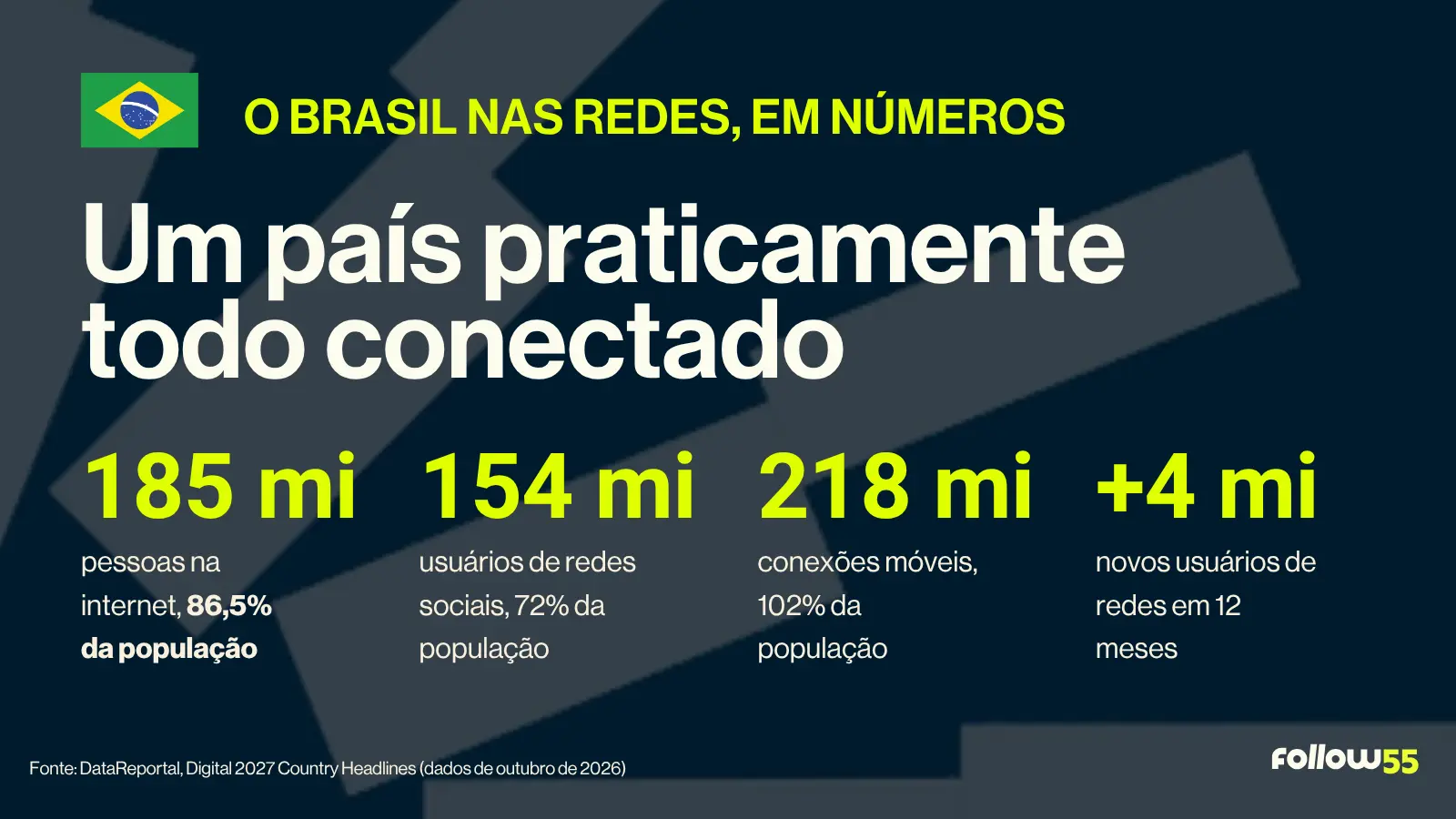
- 154 million social media users in Brazil: 72% of the population in October 2026, 4 million more than a year earlier (a 2.7% increase). The report refers to this number as "identities" because the same person can have more than one profile.
- 185 million Brazilians on the internet: 86.5% of the population, a number practically stable compared to the previous year. The growth now is less in how many people connect and more in how they use the internet.
- 218 million mobile connections: more phone lines than inhabitants, equivalent to 102% of the population.
- 19 hours and 18 minutes per week on social media and video platforms: This is the global average in 2026, 42 minutes more than the previous year, according to GWI data compiled in Digital 2027.
- Search has lost ground in brand research: The use of search engines to research brands fell from 51% in 2024 to 45.3% in 2026. Social media is already used by 41.8% of people at this stage, and artificial intelligence by 26%.
- 3.24 billion people worldwide use generative AI: 57.2% more than in October 2025.
The numbers confirm something we've already noticed in our daily lives: Brazilians live online, and the journey of discovering brands is increasingly distributed between search, social media, and artificial intelligence. The difference, as is almost always the case, lies in the details of each platform.
The ranking shows where the people are. The strategy begins when we understand where your audience is and what they expect to find there.
Ranking: The most used social media networks in Brazil
The most recent platform ranking is from Digital 2026 Brazil, with data from the end of 2025. It measures the audience each network can reach with ads, a good indicator of size. It's worth noting that these numbers don't represent unique individuals or monthly active users, and some platforms revise their databases periodically.
- YouTube, 150 million: 70.4% of the population and 81.1% of internet users, representing an increase of 4.2%.
- Instagram, 147 million: 69% of the population, with an 8% growth in one year. Among adults, it reaches 87.3%.
- TikTok, 131 million adults: The data only considers those over 18 years of age and shows a growth of 17.6%, the largest increase among major retail chains.
- Facebook, 109 million: 51.3% of the population, with a slight decrease of 1.3%.
- LinkedIn, 90 million members: 42.3% of the population, an increase of 15.4%. Here, the number refers to registered members, not active users.
- Messenger, 46.9 million: a drop of 5.1%.
- Pinterest, 42.2 million: up 4.4%, with a predominantly female audience (66.9%).
- Reddit, 19.9 million: A 286% increase, a variation that the report itself classifies as outside the norm.
- X, 17.1 million: a drop of 19.1%.
- Snapchat, 6 million: a 12% drop.
DataReportal suggests that some of the declines, such as those of Facebook, Messenger, and X, may reflect account cleanups done by the platforms themselves, and not necessarily a real reduction in usage. Even so, the general trend is clear: video, discovery, and professional content are gaining ground, while networks that relied on the logic of connecting friends are losing prominence. When the platform-specific breakdown of Digital 2027 is published, we will update this ranking.
Every new phase of the internet changes how brands need to be present.
When social media gained relevance, companies learned that it wasn't enough to communicate: it was necessary to build relationships. When smartphones became the central hub for browsing, thinking about mobile experiences became indispensable. Data from 2026 shows that we are experiencing yet another of these shifts, this time marked by video, interest-based recommendations, and the entry of artificial intelligence as an intermediary between brands and people.
Therefore, we believe that viewing the most used social media networks in Brazil merely as a list of channels is a misinterpretation. Each movement in the reports points to a different strategic decision, and it is these decisions that are worth discussing.
Using videos in the strategy
YouTube is on top, Instagram is growing, TikTok has seen the biggest jump among major platforms, and weekly time spent on social media and video continues to increase. Taken together, these figures show that video consumption continues to gain ground in people's daily lives. For brands, this means planning content with video in mind from the script stage, rather than adapting a static piece at the last minute. Video has ceased to be a gamble and has become the most natural way for a brand to communicate with its audience.
Brand research was divided between search, social media, and artificial intelligence.
Perhaps the most strategic data for 2026 isn't the size of the networks, but rather the behavior of those searching. According to GWI, the use of search engines to research brands fell from 51% to 45.3% in two years. In the same period, social networks reached 41.8% and artificial intelligence 26%. In practice, brand evaluation no longer happens in a single place: it's distributed across Google, social networks, and ChatGPT. A strategy that only considers one of these channels leaves part of the buyer's journey unanswered.
LinkedIn has established itself as an authoritative channel, including for artificial intelligence.
There are 90 million members in Brazil, a 15.4% increase in one year. For B2B companies, it's the environment where decision-makers build and consume professional reputation. There is also a less visible but very relevant effect: according to... Meltwater, Approximately 75% of LinkedIn mentions in AI responses come from personal profiles. When leaders and experts post using their own name, the brand gains reach with both people and artificial intelligence simultaneously.
When leaders publish using their own name, the brand gains reach with both people and artificial intelligence simultaneously.
Communities have become a source of answers.
Reddit's surge in popularity in Brazil needs to be interpreted with caution, but it aligns with an important global trend. Artificial intelligence has begun seeking answers within networks and communities: according to... Goodie, Social media went from 4.9% to 7.2% of the sources cited by AI tools between January and August 2026. In other words, what is said about your brand on social media starts to influence what ChatGPT and Gemini say about it. We delve deeper into this phenomenon in [reference to relevant article/section]. Social media has become a source of AI responses..
Rented reach needs to transform into a personal relationship.
Platforms change rules, revise their foundations, and redistribute reach without asking permission. The loss of space for networks that were once central, such as Facebook and X, is a reminder of this. We advocate that all audience acquired on social media should have a path into the brand's channels: website, newsletter, WhatsApp, and CRM. It is in these spaces that the relationship ceases to depend on third-party algorithms and begins to generate value over time.
Followers are still a form of reach borrowed from the platform.
Real relationships happen on the channels your brand controls.
Being on every social network shouldn't be the goal.
With ten relevant platforms in the country, the temptation is to have a presence on all of them. In practice, this usually generates generic content and overburdened teams. The smartest starting point is to cross-reference the ranking of the most used social networks in Brazil with the profile of your audience. Pinterest, for example, is small compared to YouTube, but it gathers a predominantly female audience with a strong purchase intent. For some brands, it can generate more results than networks ten times larger.
How to transform rankings into planning.
There is no single formula, because each brand has a different audience, a different moment, and a different objective. However, there is a path we use at follow55 when helping a company decide where to be and how to measure its performance, and it serves as a starting point for planning for 2027:
- Map where your audience is, not where everyone else is: Use the age and gender reach data from the reports as a reference and validate it with information from your own database.
- Define a role for each network: Discovery, authority, relationship, or conversion. A network without a clear role becomes just another obligation on the calendar.
- Plan the video as a standard: Scriptwriting, recording, and editing designed for mobile phones, with short and long versions based on the same content.
- Activate your company's people on LinkedIn: Leaders and experts who publish regularly build authority and appear more frequently in AI responses.
- Be present throughout the entire research journey: Search, networks, and artificial intelligence all need to find the same answers about your brand.
- Drive your audience to your own channels: Connect your networks, website, and CRM so that each follower has a clear next step.
- Measure what really matters: Reach and likes only tell part of the story. Also track brand searches, qualified leads, and mentions in AI responses.
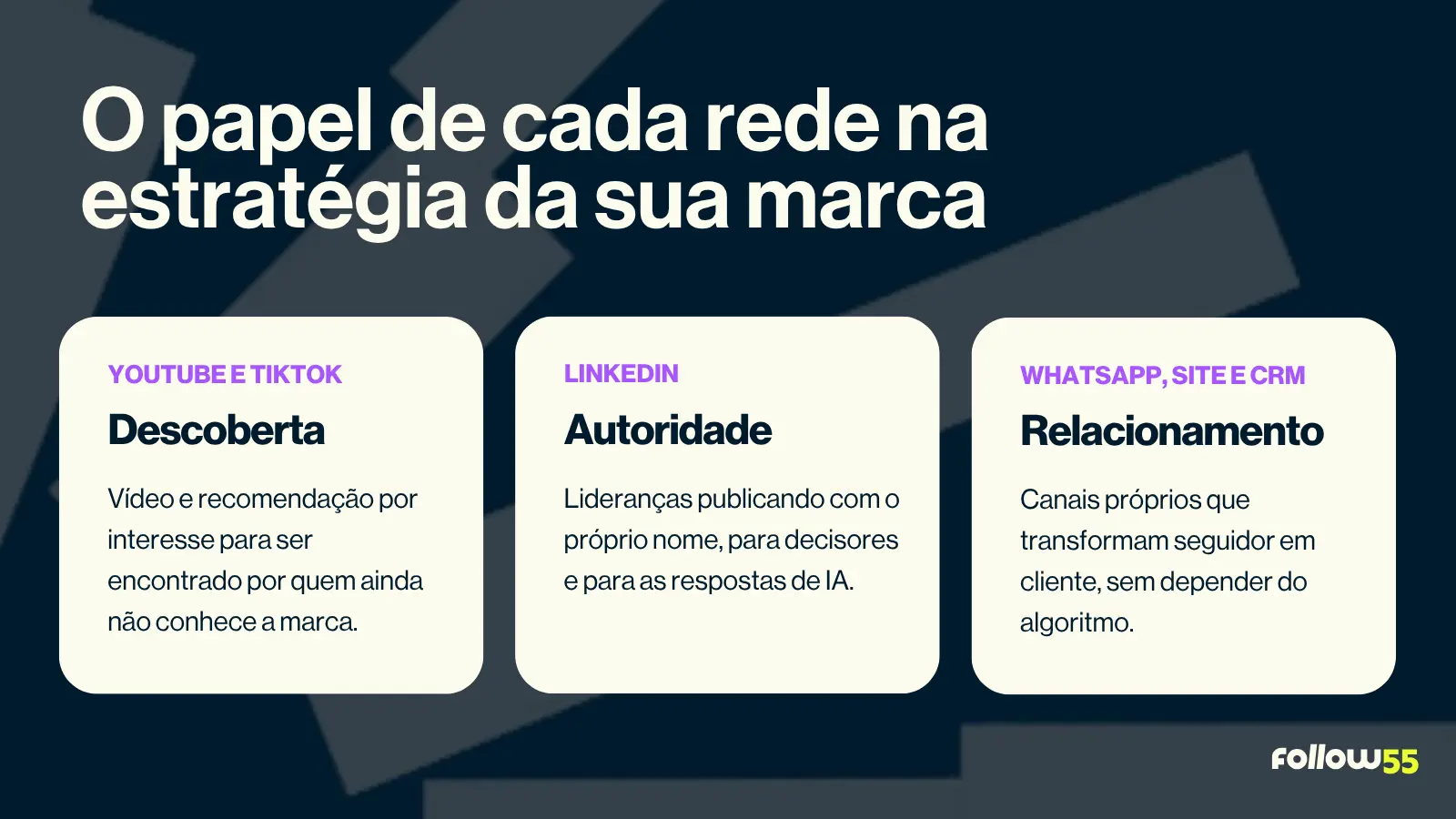
This reasoning is the basis of what we call digital ecosystemNetworks, website, content, data, and CRM working as a single system, instead of isolated channels competing for the same person's attention.
Frequently Asked Questions
What are the most used social media platforms in Brazil?
According to Digital 2026 Brazil, by DataReportal, the largest networks by ad reach are YouTube (150 million), Instagram (147 million), TikTok (131 million adults), Facebook (109 million), and LinkedIn (90 million members). This is the most recent platform breakdown published, with data from the end of 2025.
How many Brazilians will be using social media in 2026?
According to the Digital 2027 Country Headlines, Brazil had 154 million social media users in October 2026, equivalent to 72% of the population and 4 million more than a year earlier. The report calls this number "identities" because it may include duplicate profiles and does not exactly represent the total number of people.
Which social network has grown the most in Brazil?
In the most recent platform breakdown, TikTok saw the largest growth among the major networks, with a 17.6% increase, followed by LinkedIn at 15.4%. Reddit registered a 286% increase, but the report itself classifies this variation as outside the norm.
Does my company need to be on all social media platforms?
No. Ideally, you should choose the networks where your audience is and define a clear role for each one. A consistent presence on a few networks usually generates better results than a weak presence on many.
Do social media influence ChatGPT's responses about my brand?
Yes. Artificial intelligence is increasingly using content from LinkedIn, YouTube, and Reddit to formulate answers, and 26% of people already use AI to research brands. We explain how this works in [link/reference]. how to appear on ChatGPT and in the guide about What is GEO?.
Conclusion: Ready to transform audience into results?
Brazil is already on social media. What differentiates brands that grow from those that merely post is the strategy that sustains this presence: knowing where to be, what to say on each channel, and how to transform those who reach out into a genuine relationship. Rankings change every year, and will continue to change. A well-constructed strategy is what allows you to navigate these changes without having to start from scratch with each new trend.
At follow55, we help brands build this end-to-end journey, from strategy à content production, passing through growth, CRM and data.
References
- DataReportal, Meltwater and We Are Social: Digital 2027 Country Headlines (October 2026)
- DataReportal, Meltwater and We Are Social: Digital 2027 Global Overview Report (October 2026)
- DataReportal, Meltwater and We Are Social: Digital 2026 Brazil
- Meltwater: LinkedIn AI Visibility Study (2026)
- Goodie: Social Media AI Citations, 16 Sourcing Shifts (2026)




 Portuguese
 English