

Understand the difference between SEO, AEO, and GEO, why one layer doesn't replace the other, and how the three determine whether your brand is found, becomes the answer, or is cited by artificial intelligence.
For years, being found on the internet had only one address: the first page of Google. The question every marketing team repeated was: “How do we climb the rankings?”. This question still matters, but it's no longer the only one. The discovery has broken down into layers, and each layer has developed its own logic.
Today's visitor doesn't always type in a keyword and click a blue link. Sometimes they read the pre-written answer at the top of the search results and don't go to any website. Other times they ask the... ChatGPT What is the best solution to his problem? He receives three brand names, already filtered. If your company isn't prepared for these new times, it simply won't show up, and you won't even know you were left out.
In this article, we separate what are SEO, AEO and GEO, This shows why one layer doesn't replace another and explains how they combine to determine if your brand is found, becomes the answer, or is cited by artificial intelligence.
Numbers to observe
- By 2026, Google's AI Overviews (AI-generated answers) will appear in approximately 48% of searches, and most searches will end without a link being clicked. Sources: BrightEdge and SparkToro.
- In Brazil, the Leadster PRO 2026 Panorama This shows that AI is already the channel that converts the most, with a median of 7,80%, ahead of Meta Ads (3,91%) and Google Ads (3,41%).
- According to Leadster, among AI tools, ChatGPT accounts for the largest share of traffic in the country, around 78%, followed distantly by Perplexity, Gemini, and Copilot.
- On the other hand, the offering is still shallow: only 11% of Brazilian brands already have a structured strategy to appear in AI responses.
The numbers tell the same story from different angles: The search didn't disappear, it multiplied in new places.. Whoever is solely focused on Google is doing a good job of defending a shrinking territory, leaving the other two without anyone to defend them.
SEO: being found in search engines
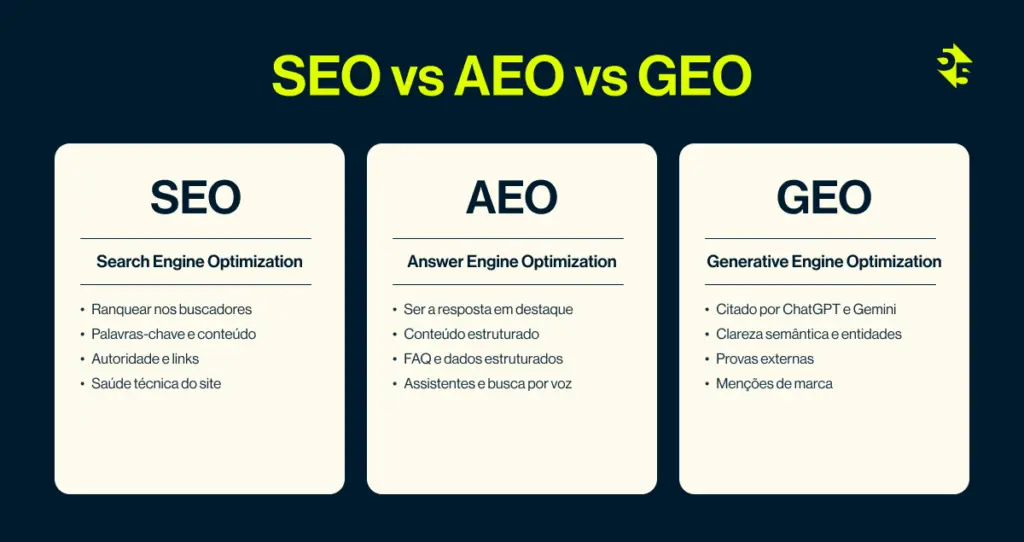
THE SEO It's the oldest layer, and it remains the foundation. It's about making your brand appear when someone searches for your category on Google, Bing, or YouTube. It's a job of thematic authority, content, website architecture, keywords, and technical soundness.
There's a common claim that "SEO is dead." We don't believe that. What's happening is more subtle: SEO has gone from being the roof of a strategy to its foundation. Artificial intelligence, in particular, relies heavily on what's already well-ranked and well-structured to formulate its answers. Those with a solid SEO foundation have a head start in the subsequent layers.
The key point is to avoid confusing the base with the entire building. Ranking well remains necessary, but it's no longer sufficient.
AEO: Be the answer, not just a link.
AEO is the acronym for Answer Engine Optimization, Optimization for response mechanisms. Here the goal changes: it's not enough to appear in the list, you want to be the answer that appears before the list.
This is what happens in Google's featured answers, in the "People also ask" section, in AI Overviews, and in voice assistants. The user asks the question and receives the answer directly, often without needing to click anything. This behavior has a name: click-free search. It's great for those who are the answer and invisible to those who aren't.
Optimizing for AEO means structuring content for easy extraction: answering questions directly and objectively, organizing titles well, maintaining question-and-answer blocks, and using structured data. Instead of writing for a machine to crawl, you write for a machine to cite.
GEO: being cited by artificial intelligence
GEO is the acronym for Generative Engine Optimization, Optimization for generative engines. It's the newest layer and the one that changes the rules the most. When someone asks ChatGPT, Gemini, or Perplexity what the best option is for a problem, the AI doesn't return ten links: it synthesizes an answer and recommends a handful of brands. Being in that handful, or being left out, is the new game.
The logic is no longer just about ranking; it's about mentions and context. AI needs to clearly understand who your company is, what it does, and why it's trustworthy, and this is built with semantic consistency, well-defined entities, external evidence, and content that effectively answers your market's questions. We delve deeper into this topic in [link/reference]. What is GEO and how to appear on ChatGPT?.
One question to conclude this section: do you know how ChatGPT describes your brand today? If the answer is "no," it's worth measuring. That's exactly what we investigate in [this section/method]. Digital Reputation Diagnosis.
The difference in practice: three layers that add up.
The clearest way to see SEO, AEO and GEO It's not like competitors, it's like stacked layers. Each one answers a different question about its presence:
- SEO: When someone searches for your category on Google, does your brand appear in the results?
- AEO: When a search engine delivers a ready-made answer before the list, is it your brand that's on that list?
- GEO: When someone asks an AI, is your brand one of the ones they recommend?
Did you notice that the requirements increase with each step? At the first level, simply showing up is enough. At the second, you need to be the best answer. At the third, you need to be a brand that the machine understands and trusts enough to recommend. A brand can do very well at the first level and disappear at the other two, and that's precisely where most companies are losing ground without realizing it.
This is not the end of SEO, it's the expansion of search.
We advocate for a hype-free interpretation: SEO is not over, and GEO is not a passing fad. What has happened is an expansion. Search no longer resides in just one place and now happens in three, and your brand needs to be consistent across all three, because it's the same brand that the person finds in the link, the featured answer, and the AI recommendation.
We've experienced similar transitions before. When social media arrived, it didn't kill websites, but it forced brands to exist on more than one channel simultaneously. When mobile arrived, it was the same thing. AI is the game-changer this time, and it rewards those who understand early on that digital presence has become an ecosystem, not just a channel.
Frequently Asked Questions
What is the difference between SEO and GEO?
SEO optimizes your brand to appear in search engine results, such as Google. GEO optimizes your brand to be understood and cited by artificial intelligence tools, such as ChatGPT and Gemini. One focuses on ranking in a list of links, the other on being recommended within an AI-generated response.
What is AEO?
AEO stands for Answer Engine Optimization. It's the work of structuring your content to become the direct answer that appears in searches, such as Google's featured answers and voice assistants, instead of just being another link in the list.
Does GEO replace SEO?
No. Geosearch (GEO) doesn't replace SEO; it complements it. Artificial intelligence relies heavily on content that is already well-ranked and well-structured, so a solid SEO foundation strengthens your GEO. They are complementary layers, not mutually exclusive.
How can I get my brand to appear on ChatGPT?
Appearing in ChatGPT responses depends on semantic clarity, structured data, external evidence, and content that effectively answers your market's questions. We explain the path in detail in the article about... What is GEO?, and we measure how AI sees your brand in Digital Reputation Diagnosis.
What is GEO in a company?
In practice, GEO in a company means treating AI presence as a separate work stream, with a designated person, method, and monitoring. It means tracking how artificial intelligence describes and recommends your brand, and optimizing content and data to ensure that description is accurate and favorable.
Ready to discover where your brand is losing ground?
At follow55, we believe the right question has shifted from "Is my brand at the top of Google?" to "Is my brand found, is it the answer, and is it cited?". These three layers together tell the complete story, and it's rare for a company to excel in all three without having intentionally sought to do so.
The first step is to measure. In Digital Reputation Diagnosis, We map how your brand appears on Google, in featured results, and in AI searches, and deliver the few moves that generate the most impact. When the diagnosis indicates that the bottleneck is in acquisition, the team... Growth He stepped in to execute. That's how it was in projects like TasteWay, our most recent project, as well as in collaborations with brands like NIVEA and Alpargatas.
The search has multiplied. The good news is that there's still a lot of empty space, because most companies haven't even realized the game has changed. Whoever understands this first will occupy that space before it becomes expensive.
References
- Gartner. Gartner Predicts Search Engine Volume Will Drop 25% by 2026, Due to AI Chatbots and Other Virtual Agents (2024).
- Leadster. Overview of Lead Generation in Brazil (PRO Panorama 2026).
- follow55. What is GEO (Generative Engine Optimization)?






 Portuguese
  English