

Understand what CRM is, why it matters at each stage of a company's growth, and what separates those who truly use it from those who only pay for a license.
Explain what it is. CRM And talking about its importance might seem redundant. The acronym has been around for over two decades, the tools have become accessible, and almost everyone has heard that "you need to have one." Even so, most Brazilian companies continue to sell via WhatsApp, noting everything in spreadsheets and relying on the memory of the person who answers the phone to remember who needs a callback.
This happens because CRM is often presented as software, and software seems like something only for large companies or structured sales teams. In practice, the question it answers is much simpler and applies to any size company: what does the company know about its own customers, and who can use that information at the right time?
In this article, we explain What is CRM?, This article discusses what the data reveals about the Brazilian market and details the importance of CRM for small, medium, and large companies, including what changes at each stage and where to begin.
What is CRM?
CRM is the acronym for Customer Relationship Management, Customer relationship management (CRM) is a term that describes both a way of working and the tool that supports it. The way of working involves organizing all interactions with customers and potential customers in one place, with history, responsible party, and next step. The tool is the system where this is recorded, with a sales funnel, tasks, automations, and reports.
The distinction is central to understanding what CRM is in practice, because it explains why so many companies have CRM and don't reap the rewards. The system stores what someone is willing to record, and nobody records what doesn't help their own work. When the way of working hasn't been designed, the tool becomes just another open tab in the browser.
The magnitude of the issue, in numbers.
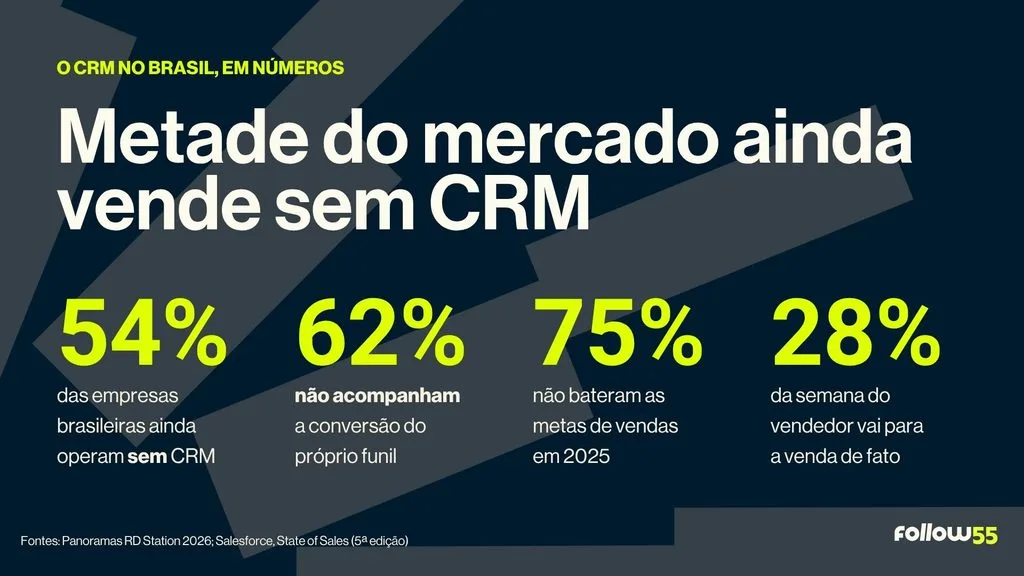
- Half of the market still operates without CRM: According to the RD Station 2026 Panoramas, with responses from approximately 2,800 marketing and sales professionals, 54% of Brazilian companies still operate without a CRM tool.Media & Message).
- The funnel is a blind spot: The same survey shows that 621% of companies do not track the conversion rates of their own sales funnel and that 751% of companies did not meet their sales targets in 2025.
- WhatsApp has become the counter.The research indicates that the app is the main commercial tool for Brazilian companies, which means that a large part of the negotiation history exists outside of any system.
- Size does not guarantee maturity. In Agendor's 2026 Industrial Sales Panorama, CRM usage grows up to the medium-sized industry, where it reaches 79%, and falls to 47% in the largest range of companies surveyed (Agendor).
- Seller sells little: Salesforce's State of Sales report shows that sales representatives dedicate only 28% of the week to actual sales, with the remainder consumed by deal management and data entry.Salesforce).
The numbers show that understanding what CRM is and using it effectively doesn't depend on company size. Small operations fail to record data due to a lack of infrastructure, and large operations also fall behind when data is scattered across departments, branches, and systems that don't communicate with each other.
The importance of CRM for small businesses
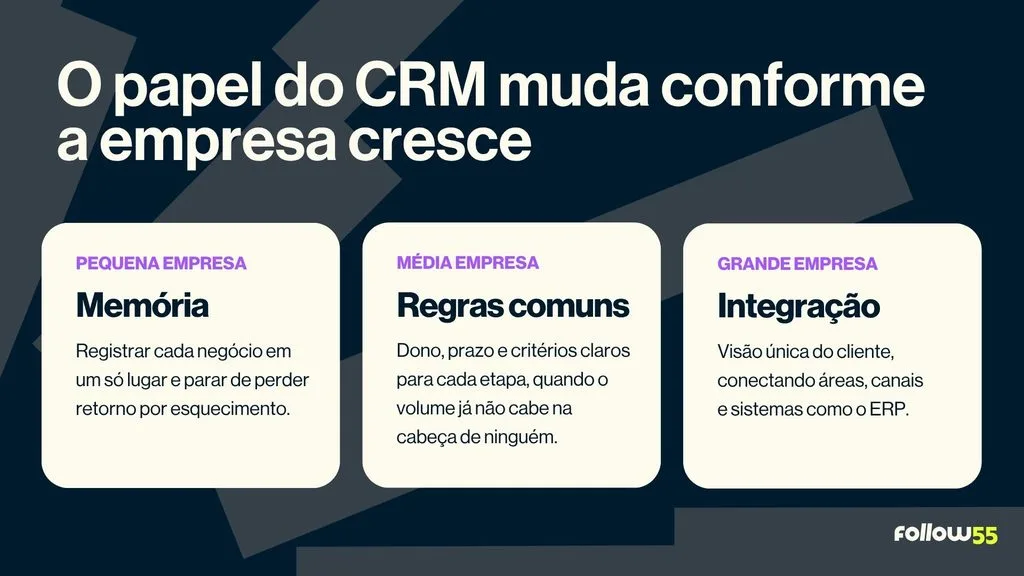
In small businesses, the importance of CRM lies in solving a problem of memory. The owner or a small team handles, sells, and delivers simultaneously, and a lead who requested a quote on Tuesday can easily go unanswered until the following week. Each sale lost due to forgetfulness weighs much more heavily when the client base is small.
For small businesses, understanding CRM in practice means realizing it doesn't need to be sophisticated. A funnel with few steps, follow-up reminders, and each client's history all in one place can already change their routine. The most immediate benefit is usually the peace of mind of knowing what's open, who needs a response today, and where clients are coming from. For those who have grown through referrals, it's also the first step in understanding if there's a pattern that can be intentionally replicated.
The importance of CRM for medium-sized businesses
Medium-sized companies are going through their most delicate phase: the volume of work is overwhelming, but the processes are still those of the era when everyone knew each other. Salespeople with their own portfolios are emerging, leads are arriving through websites, social media, events, and referrals, and managers need to predict the month's results without seeing the sales funnel.
At this stage, the importance of CRM lies in creating common rules. Who owns each lead, how quickly they need to be attended to, what defines when a negotiation has advanced to the next stage. It's also when marketing and sales start needing the same database, and when relationship management rules and automations begin to save hours of repetitive work. Without this, growth happens, but with a loss of opportunities that no one can measure.
The importance of CRM for large companies
In large companies, the challenge is no longer about organizing, but about integrating. The data exists, but it's divided among departments, business units, service channels, and legacy systems. The customer who speaks with sales, support, and finance is often treated as three different people.
That's why Agendor's data is noteworthy: commercial maturity doesn't automatically grow with size. For large operations, the answer to what CRM is changes scale: it's the layer that connects these ends, provides a single view of the customer, and supports revenue forecasting, segmentation, and personalization decisions at scale. It's also the starting point for data and artificial intelligence initiatives, which depend on a reliable foundation to function.
What changes when CRM really works?
- Company history: The customer history no longer depends on who provided the service and remains available even when someone leaves the team.
- Predictability: With the sales funnel tracked, it's possible to know how much is still under negotiation, where sales are stalled, and what to expect in the coming months.
- Ongoing relationship: Rulers and automation maintain contact with those who haven't yet purchased and with existing customers, without relying on reminders.
- Time to sell: Integrations with websites, WhatsApp, and email reduce typing and give the team back some of the week that is currently spent on operational tasks.
- Basis for AI: Automated summaries, next-step suggestions, and lead qualification only work well on organized data.
Why do so many companies have CRM but don't use it?
- Let's start with the tool: Comparing plans and features before understanding how sales work today leads to choosing from the catalog, not based on real needs.
- Drawing the funnel in the boardroom: Steps that make sense on the slide, but don't correspond to what the client experiences, lead to stalled negotiations where no one knows when to move forward.
- Not assigning an owner and deadline to each lead: A lead without an assigned owner goes cold, and no system can resolve a rule that the company hasn't decided on.
- Leave WhatsApp as a secondary channel: If the main conversation happens outside the system, the CRM will never have the history that justifies its existence.
- Wanting to measure everything from the start: Dozens of required fields turn each record into a form, and the team starts avoiding the system.
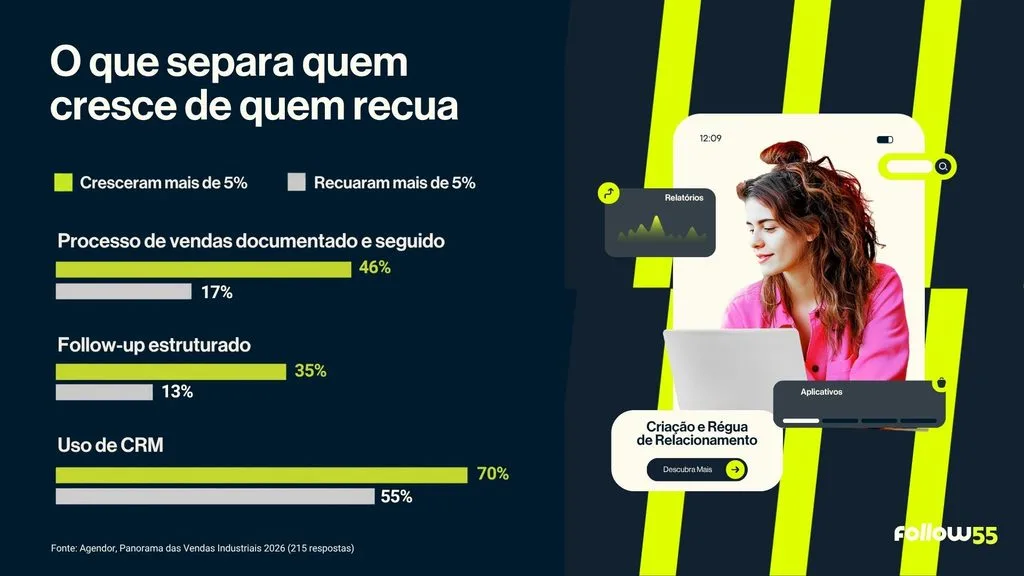
A survey by Agendor covering more than 200 industries helps to illustrate this. Among companies that grew more than 51% of their market share (TP3T), 46% have a documented and followed sales process, compared to 17% among those that declined. CRM usage is also higher among those growing, but the gap is much smaller: 70% versus 55% (TP3T).Agendor).
How to get started, at any size.
After understanding what CRM is and its role at each company size, the approach we advocate is the same for a company of five people or five hundred, only the scale changes. First, a diagnosis of how sales happen today, with a simple baseline: how many contacts arrive, how many go unanswered, how long does it take to get a response. Then, a minimum funnel of four to six stages with clear criteria for passing through and rules of ownership and deadline for each negotiation.
With this system in place, integrations that free up work for the team and a weekly ritual using the CRM as the official source of the sales funnel come into play. Automations and artificial intelligence come last, as accelerators of a process that already exists. The RD Station 2026 Panoramas show that only 20% of companies using AI report concrete gains in conversion or sales accuracy, and we believe that a large part of the difference lies precisely in this base.
In practice: what we observe in the projects
At follow55, an RD Station partner, the CRM projects that come to us rarely begin with a request for sophisticated automation. The most common starting point is an operation that has grown through referrals, with leads arriving through various channels and no consolidated view of what is currently underway.
In these cases, the first noticeable gain is almost never "selling more" in the first month. It's knowing what's happening: how many opportunities are open, which ones are stalled, who needs a response today. This clarity underpins everything that comes after, from relationship management strategies to lead scoring. This is also why CRM works best when it's considered part of a [missing word - likely "strategy" or "solution"]. digital ecosystem connected to the website, media, and data, and not as a tool isolated from the sales team.
As a partner of RD Station, we also implement and configure the platform's tools, such as RD Station CRM and RD Station Marketing, for those who choose this path. The order remains the same: first the sales process, then the tool. The difference is having an implementation done by someone who knows the platform inside and out and the Brazilian market in which it originated. Learn more about us. Follow55's partnership with RD Station.
Frequently asked questions about CRM
What is CRM and what does the acronym stand for?
CRM stands for Customer Relationship Management. The term refers both to the strategy of organizing all interactions with customers and to the system that records these interactions, including history, sales funnel, and automations.
Does every company need a CRM?
Yes. Having a CRM for companies that rely on relationships to sell makes a difference, regardless of size. What changes is the complexity: a small company can start with a simple sales funnel, while a large operation needs integrations between departments and systems.
What is the difference between CRM and ERP?
ERP systems organize a company's internal operations, such as inventory, finances, and invoicing. CRM systems manage relationships with current and potential customers, from initial contact to after-sales service. The two complement each other and, ideally, exchange data.
What is the best CRM for small businesses?
The best CRM is the one the team will use every day, and that depends more on the sales process than on the list of features. For operations that sell a lot through WhatsApp, it's worth prioritizing good integration with that channel. Follow55 is part of that. RD Station partnership program, But the choice always starts with the diagnosis.
How much does it cost to have a CRM?
The investment varies depending on the tool, the number of users, the necessary integrations, data migration, and the level of support during implementation. Therefore, every serious budget begins with a well-prepared briefing that clearly outlines what needs to be addressed first.
Ready to put CRM to work for your company?
And for those who choose RD Station, we are partners with the platform and implement RD Station CRM from start to finish, from funnel design to website and WhatsApp integrations.
Ultimately, CRM shows every day how well a company knows its own customers, and that's why it's worth starting the right way.
References
- Media & Message. Companies want to grow in 2026, but failed to meet their targets in 2025. (coverage of the RD Station Panoramas 2026).
- RD Station. Panoramas RD Station 2026.
- Agendador. Overview of Industrial Sales 2026.
- Salesforce. State of Sales, 5th edition.




 Portuguese
 English