
Digital


Priscilla Jacovani
Co-Founder & Managing Partner
How Generation Z uses social media and what that means for brands.
March 20, 2026
Digital


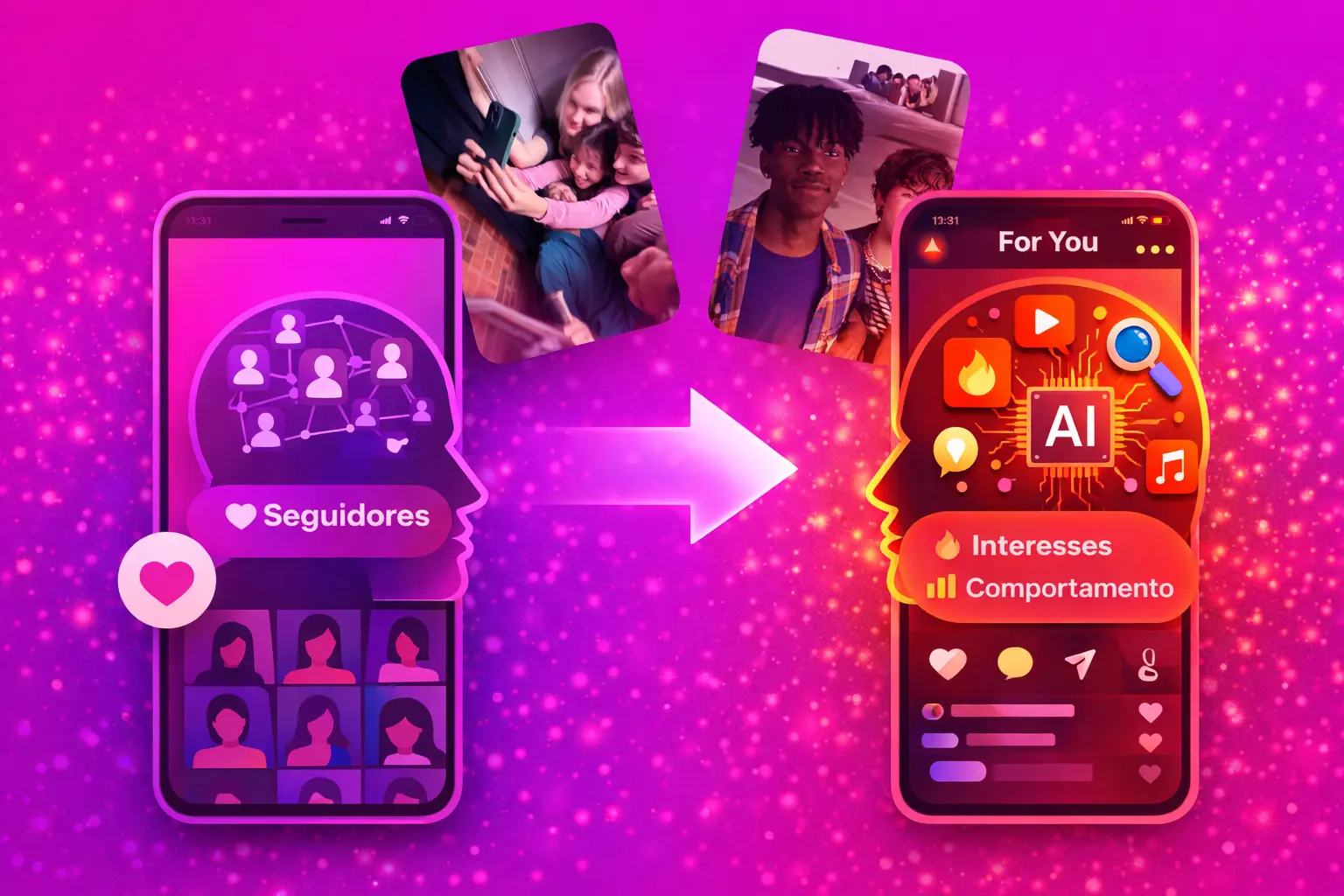
THE Instagram It is currently undergoing one of the most significant transformations in its history. This is not just an interface update or the prioritization of a new content format. What is happening is a structural change in how the platform organizes, distributes, and values information.
With the new experience, based on full-screen vertical videos, seamless browsing, and increasingly aggressive recommendations, Instagram is getting closer of the model that made TikTok dominant: an interest-driven environment, Not by connection.
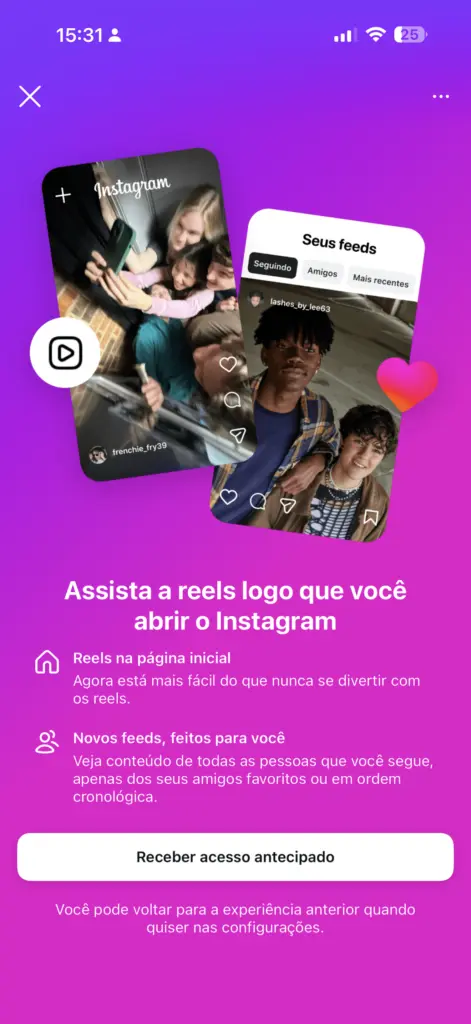

This change, although it may seem technical at first glance, has profound implications for brands. Because it alters not only the format of the content, but also the logic that underpins growth, reach, and relevance within the platform.
For years, the Instagram It operated under a relatively simple premise: building an audience was the main strategic asset. Brands invested in follower growth, consistent posting, and visual identity, based on the assumption that by accumulating a relevant base, they would guarantee continuous distribution for their content.
This model worked because the platform was strongly anchored in what was called... social graph, In other words, distribution was directly linked to connections between users. In other words, content circulated primarily among those who already had some kind of established relationship with that profile.
What is becoming established now is a break with this model.
Instagram will now operate based on a interest graph, In this model, the relevance of content is defined by user behavior, not by their network of connections. This means that the feed ceases to be a reflection of relationships and becomes a reflection of interests.
In practice, this completely shifts the strategic focus.
It stops being just about how many people follow a brand.
It becomes important how many people actually choose to consume what she publishes.
This transition has an immediate effect: a loss of predictability in reach.
While it was previously reasonable to assume that a significant portion of the follower base would be impacted by each post, this is no longer true. Content is now distributed based on performance signals, regardless of the profile's origin.
This creates a scenario in which two phenomena come to coexist:
This behavior, common on platforms like TikTok, redefines the dynamics of growth. The profile ceases to be the main distribution vector. Each piece of content is now evaluated individually, as an autonomous unit.
This is where the platform's logic becomes closer to a media model than a traditional social network.
By operating in this way, Instagram transforms each post into an experiment.
The algorithm observes, in real time, signals such as retention, engagement speed, sharing, and repeat views. These indicators determine whether the content will be expanded to new audiences or whether its distribution will be interrupted.
This Instagram dynamic introduces a new criterion for success: performance.
Content is no longer just a brand expression or a vehicle for institutional communication. It becomes a performance unit that needs to quickly prove its ability to generate attention and engagement.
This brings content production closer to a logic historically associated with paid media, in which results determine investment and scale.
With Instagram's new distribution logic, the type of content that tends to perform best is also changing.
For a long time, Instagram valued aesthetics, curation, and visual consistency. Organized feeds and refined art direction were central elements in building a presence.
These attributes still have value, but they cease to be the determining factors.
The critical factor becomes the ability to quickly capture attention and sustain interest throughout the experience. In a highly competitive, continuous consumption environment, content that fails to engage within the first few seconds simply doesn't advance through the distribution system.
This leads to a noticeable shift in the platform's dominant language:
The logic shifts from "how the brand wants to present itself" to "how the content can be consumed.".
Another relevant effect of this transformation is the expansion of the competitive landscape.
Previously, brands competed primarily with other brands within a relatively limited space. Today, they compete for attention with any type of content that can perform within Instagram's algorithm, including independent creators, pure entertainment, and rapidly spreading cultural trends.
This changes the nature of the competition.
It's no longer just about positioning or market differentiation. It's about the ability to compete for attention in a continuous stream of stimuli.
In this scenario, traditional institutional content tends to lose ground. Communication needs to move towards formats that are both relevant to the brand and competitive within the platform's dynamics.
Given this new Instagram model, some implications become clear.
The first is that content becomes one of the main drivers of acquisition. Brand discovery on Instagram happens within the feed itself, mediated by the algorithm, and not just through active searches or direct access to the profile.
The second point is that volume and consistency cease to be merely best practices and become operational requirements. Since each piece of content is an experiment, increasing the number of attempts also increases the likelihood of identifying formats that perform well.
The third point is that creativity needs to be data-driven. Not in the sense of stifling creation, but of understanding which narrative, visual, or structural elements contribute to retention and engagement.
Finally, branding needs to be incorporated into the content itself. There is no longer a clear separation between "performance content" and "institutional content." Brand building happens within the consumer experience, not just on its aesthetic surface.
Despite all the complexities, this transformation brings an important consequence: the reduction of barriers to entry.
In a performance-driven model, relevant content can scale regardless of brand size or its history on the platform. This opens up opportunities for accelerated and, in some cases, exponential growth.
On the other hand, this same model increases the level of demand.
While it used to be possible to maintain a presence on Instagram based on consistency and organization, now it's necessary to compete effectively for the user's attention. This requires creative repertoire, adaptability, and constant monitoring of performance.
Instagram hasn't stopped being a social network, but it has ceased to operate exclusively as one.
It is increasingly establishing itself as an algorithm-driven content distribution platform, where attention is the main resource and performance is the primary criterion.
For brands, this requires a change in mindset.
Simply being present, publishing frequently, or maintaining visual consistency is no longer enough. It's necessary to create content that is relevant within a highly competitive environment, where each piece of content needs to justify its own existence.
Ultimately, what is at stake is not just adapting to a new format, but the ability to operate within a new logic.
And, as with any structural change, those who understand this logic first tend to seize the greatest opportunities. Follow55.com.br can help at this time. Follow us! Instagram and learn more about our work. You can also contact us by here.
Digital