Digital Reputation: The 6 Layers That Support Your Brand
Digital
May 14, 2026
Written by:
Priscilla Jacovani
Co-Founder & Managing Partner
To share
For a long time, building a digital presence was simple. An institutional website. Active social media accounts. Paid media campaigns running. This combination was enough to put any company in a competitive position.
This world has ended.
Today, brands are not just competing for human attention. They are competing for... algorithmic interpretation. Your company is being read all the time by search engines, artificial intelligence and recommendation systems. It is the platforms that decide what deserves relevance.
The false sense of digital presence
There is a common misconception in the market: To think that a brand is "doing well digitally" because it publishes content frequently or has an organized aesthetic on social media. However, presence is not the same as relevance.
Many companies are active every day, yet they remain virtually invisible to those who matter.
The digital environment is no longer linear. The old journey was predictable:
See the ad.
Access the website
Get in touch
Today's journey is fragmented. Before making any decision, people:
They search on Google.
They look for references on LinkedIn.
They read reviews.
They consume content.
They watch videos.
They ask questions to AIs like ChatGPT, Gemini, Claude and Perplexity
Each of these steps is a different interpretation of your brand. Done by a different interpreter. With their own criteria.
The pattern that we began to notice
In recent years, in repositioning and digital development projects, we have identified a pattern.
Companies that seemed to be doing everything right on traditional platforms were starting to disappear in environments that no one was measuring. Organic search. AI assistants. Communities. Algorithmic recommendations.
The reputation built up over years no longer carried the same weight in these new spaces.
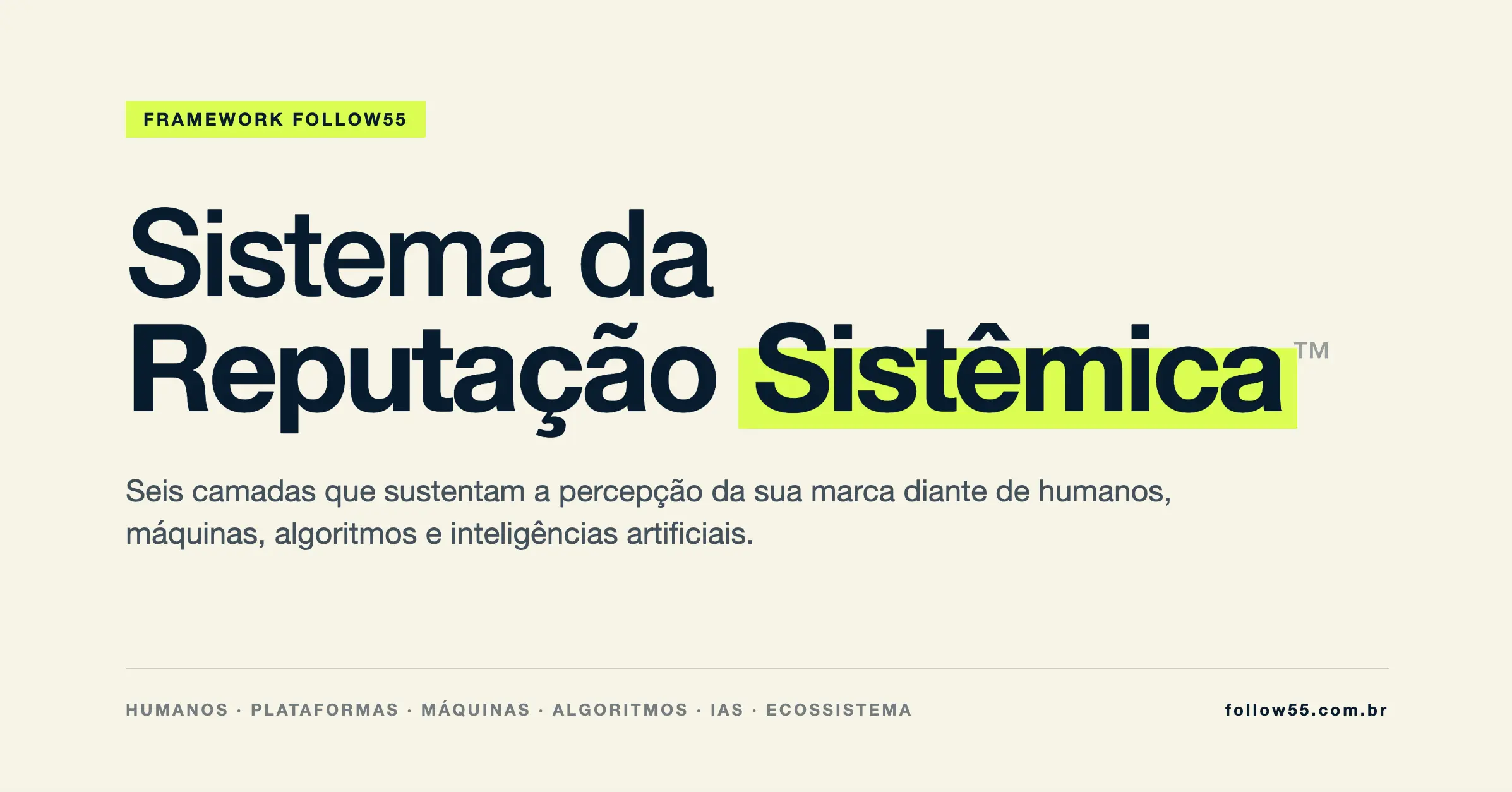
It was from this observation that we structured the Systemic Reputation System™.
This is the framework we use in follow55 to diagnose and organize a brand's digital reputation. It describes the six layers that underpin the perception of a company today.
Each layer has a different interpreter: Humans, platforms, machines, algorithms, artificial intelligence, and the company's own ecosystem.
Each interpreter has their own criteria. And each one tells a different version of their brand to whoever is making a decision.
Systemic Reputation System™ — follow55
Framework follow55
System of Reputation Systemic™
Six layers that underpin your brand's perception in the eyes of humans, machines, algorithms, and artificial intelligence.
01
System Memory
Interpreted by humans
What is it
It strengthens brand recall, recognition, human authority, and endorsement.
Environments
LinkedIn, Instagram, events, networking, communities, WhatsApp, word of mouth.
Risk
Your brand is no longer remembered by the market.
How does follow55 analyze?
Social presence, brand perception, leadership relevance, engagement, and signs of authority.
When someone thinks about the problem we solve, does our brand come to mind?
02
System Validation
Interpreted by humans + platforms
What is it
It strengthens trust, credibility, and professional perception.
Environments
Website, Google Business Profile, Instagram, LinkedIn, reviews, case studies, media.
Risk
Your company conveys insecurity or a lack of authority.
How does follow55 analyze?
Audit of digital presence, visual and verbal consistency, UX, online reputation, and social proof.
When people research our company, does it inspire confidence?
03
System Integrity
Interpreted by machines + technical systems
What is it
It strengthens the technical structure, stability, and reputational protection.
Environments
Google Search Console, PageSpeed, browsers, servers, indexers, crawlers.
Risk
Technical problems harm discovery and reputation.
How does follow55 analyze?
Technical analysis, technical SEO, speed, security, crawling, indexing, and digital health.
Does our infrastructure strengthen or harm our reputation?
04
System Discovery
Interpreted by algorithms + search engines
What is it
It strengthens the ability to be found organically.
Environments
Google, Bing, YouTube, organic search, SEO, recommendation engines.
Risk
Digital invisibility and dependence on paid media.
How does follow55 analyze?
SEO, subject authority, content, keywords, architecture, and organic presence.
When someone searches for our category, does our brand appear?
05
System Interpretation
Interpreted by artificial intelligences
What is it
It strengthens semantic clarity, context, and informational authority.
Do artificial intelligences understand who we are and what we do?
06
System Stay
Interpreted by its own ecosystem
What is it
It strengthens the development of proprietary digital assets.
Environments
CRM, newsletter, automations, lead database, community, first-party data.
Risk
Excessive reliance on external platforms.
How does follow55 analyze?
Digital maturity, proprietary assets, automation, retention, and data intelligence.
If the platforms change tomorrow, what will remain ours?
Why think in terms of systems, and not isolated actions?
Most of digital reputation diagnostics What I find in the market still looks at channels:
How much to invest in SEO
How many followers on Instagram
Which consultancy to hire
What media strategy to adopt
It's a model inherited from the previous world. From when the decision-making journey was predictable and linear. The problem with this model: it treats reputation as sum.
The expectation is that investing in each channel in isolation will add presence, authority, and reach. That's not how it works today. When someone wants to understand who a company is, they don't consult just one channel. They search on Google. They read a news article. They open LinkedIn. They ask on ChatGPT. They look at Instagram. They talk to a colleague.
Each step is an interpretation. Each interpretation is done by a different interpreter, with their own criteria.
Thinking of reputation as a system means understanding that the six layers do not compete with each other. They support each other:
A brand that is remembered tends to be better validated.
A technically sound brand is better discovered.
A well-discovered brand is better interpreted by AIs.
A brand that builds its own assets reduces its dependence on platforms.
Digital reputation isn't something you add up. It's something you build.
Where to begin?
The first step is not to execute. It's to diagnose.
I see companies starting the year with a plan full of tactical actions. SEO, content, campaigns, automation, AI. All at the same time, without clarity about where the real gaps are. The result is a budget spread across layers that were already doing well, while others remain invisible to the market.
Before deciding where to invest, it's worth asking a question for each of the six systems. How is this system currently performing in my company? Where are the weaknesses? Which one, if strengthened first, will support the others?
The patterns I most frequently encounter in this analysis are threefold. Brands that talk about generative AI internally, but haven't yet structured their own content to be correctly interpreted by these same AIs. Companies that continuously invest in paid media without building proprietary databases, and are therefore at the mercy of any platform change. Leaders who demand a greater presence on social media when the company website has serious technical problems that limit its reach. organic reach on Google.
Diagnosing means looking at the brand from six angles simultaneously. Not to solve everything at once, but to decide clearly where to begin.
Digital reputation is a living system.
It is not built by a single campaign, action, or platform. It is built by the combination of everything your brand emits, and by how each interpreter reads that emit.
When one layer fails, the entire system loses strength. When all layers work together, the brand exists in a resilient, discoverable, and credible way in any environment where it is sought. In a customer conversation. On the first page of Google. In the response of a generative AI.
In the follow55, Based on this model, we assess where a brand is and where it needs to go. We conduct systemic reputation diagnostics for companies that want to objectively understand the current state of each of the six layers and where to focus their efforts first.
If you lead a company that aims to gain more space in today's digital environment, let's talk about diagnosing your brand. Request an initial analysis..